
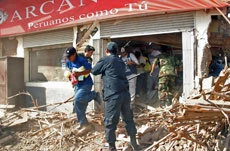
LIMA, Peru, 20 August 2007 — Authorities bolstered the troop and police presence in the earthquake-shattered zone south of Peru’s capital Saturday after a wave of looting targeted shops, relief vehicles and aid storage sites.
Hundreds of reinforcements were posted along highways and in the hard-hit cities of Chincha, Pisco and Ica, all of which reported incidents of pillaging. Three days after the devastating 8.0-magnitude quake struck, killing about 500 people and injuring 1,500 others, tens of thousands of people remained without even temporary housing and a regular supply of water and food. Much of the damaged territory still lacks electricity and running water.
“We are going to establish order in an energetic fashion,” President Alan Garcia told Peruvian radio.
But the president stopped short of declaring martial law and attributed the heavily publicized looting to small groups of delinquents. He also blamed the media for blowing the problem out of proportion.
“Some people exaggerate, and that’s not good,” said Garcia, whose political future could be staked on the government’s reaction to the quake.
Garcia’s popularity had been in a downward spiral even before Wednesday’s catastrophe. He is keen to avert the kind of unfavorable reviews President Bush received for his handling of Hurricane Katrina two years ago.
But the reports of large-scale pillaging, combined with continued protestations of slow-arriving aid in the quake zone, have put Garcia on the defensive a little more than a year after he took office in his second presidential term.
Complaints are rising throughout the stricken zone that the tons of relief supplies and millions of dollars in aid from abroad that have flooded into Peru are not getting to those who need it most. Images of looters scampering off with water, fish, meat, diapers and other stolen items have flooded the news, contradicting the government message that everything was under control. Supply depots with medicines and other help for quake victims were among the sites reported to have been targeted by looters.
The escape of more than 500 convicts from a penitentiary in Chincha that was damaged during the quake have added to fears of insecurity. Interior Minister Luis Alva Castro said many had been recaptured. Severe looting has been reported in the town.
News accounts here indicated that roving thieves were taking advantage of the region’s broken highway system to assault aid vehicles.
The pillaging was an indication of deep frustration and misery in the quake zone.
The hard-hit coastal city of Pisco, home to 130,000 people, has been transformed into a chaotic, rubble-strewn refugee camp. As many as 70 percent of the buildings were destroyed, officials say.
Survivors, who must rely on infrequent handouts and whatever else they can scrape up, have greeted visiting officials with jeers and cries that they have been abandoned.
With aid efforts concentrated in urban areas such as Pisco and Ica, rural residents who also lost homes and loved ones in the temblor claim that they have been ignored.
“No one has been here to help us,” an ailing grandmother, Trinidad Delgado, 70, said as she showed reporters her destroyed adobe home in the village of Santa Rosa, just outside Pisco. “We’re sleeping outside, making fires to stay warm. We eat what little we can come up with. We need help.”
The government has stood by its actions.
“Those affected exaggerate when they say help doesn’t arrive,” President Garcia told reporters Saturday in Pisco. “It’s a negative sensation caused in part by the desperation produced by the disaster.”
Critics have accused the administration of greater showmanship than effectiveness, arguing that some ministers would have been better off working in the capital on problems of distribution and coordination.
“President Garcia committed a grave error in dispatching to Pisco his ministers with their cars and their bodyguards, with no plan, to end up isolated in that city,” said Carlos Bruce Montes de Oca, an opposition congressman.
Garcia and his team have insisted that aid is getting to the places where it is needed and that “no one will die of hunger or of thirst,” as he told a Peruvian radio station Saturday.
“The government is doing all it can to ensure that help arrives to everyone,” Garcia said. “I ask for a little patience.”