
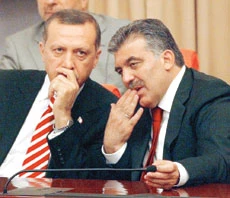
ANKARA, 21 August 2007 — Foreign Minister Abdullah Gul won most votes in the first round of a presidential election in Turkey yesterday, but did not secure the two-thirds majority needed in Parliament for an outright win.
Gul, an Islamist distrusted by the secular elite, is expected to finally defeat his two rivals in a third round of voting on Aug. 28, when he needs just a simple majority to win.
Turkey’s powerful military and secular elite blocked his first bid to become head of state in April because of his Islamist background, triggering a parliamentary election in July which was intended to defuse the crisis over the presidency.
Gul’s center-right pro-business AK Party has been strengthened by its convincing election win but is short of the two-thirds majority in Parliament needed for him to be elected president in the first or second round of voting.
The presidency has traditionally been held by the secular elite and an Islamist has never been elected president. Victory for Gul, 56, would complete the AK Party’s capture of all key posts in Turkey’s political hierarchy.
Gul secured 341 votes in the 550-seat chamber, with no other party supporting him. Quorum was achieved, validating the vote despite a boycott by the largest opposition CHP.
The first vote in April was derailed by a court ruling that two-thirds of Parliament had to be present to make the process valid — impossible amid an opposition boycott.
The army, which undermined the April vote when it threatened to intervene in the election process, has signaled that it will not get involved again. As recently as 1997 the army ousted a government in which Gul served because it was seen as Islamist.
Turkey’s financial markets had been troubled by the dispute that derailed Gul’s first election bid, but are now more focused on volatility in global markets because Gul’s eventual victory is widely regarded as a foregone conclusion.
Turkey’s lira came off earlier highs to trade at 1.3510 against the dollar, still firmer on the day.
The presidential campaign has brought to the surface the great divide among Turks, who are predominantly Muslim, over the role of religion at a time of rapid economic and social change.
The foreign minister says he supports secularism, but opposition from the secularist elite remains fierce as they accuse the AK Party of seeking to break down the division between state and religion.
“If I am elected president, I will be careful with maintaining the balances within the country’s administrations,” Gul told reporters before the vote.
Having Gul as commander-in-chief would irritate a military establishment that sees itself as the ultimate guardian of the secular state and has removed four governments in 50 years.

