
TO the hungry eye, the humble cupcake is a thing of beauty that neither challenges the ravenous consumer with the mysteries of its genesis nor stimulates long bouts of philosophical contemplation — unless, that is, you are of the same ilk as Marcel Proust about madeleines. Rather it is simply to be eaten.
Patiently accepting its lot as an object of desire of an insatiable appetite and resigning itself to a short life without any time to develop meaningful relationships with others of its kind, it patiently accepts that it is “here today and gone tomorrow.” However, that humble product of the baker’s art embodies craft, science, leading edge technology and quality control to an extent that quite boggles the mind. The technology and care that go into the creation of that attractive staple of the school lunchbox are fused into a smoothly operating 24 hour production process. The products of this appliance of science are deceptively simple; the process behind it is most definitely not.
One cupcake is such a simple object to create that kindergarten children make them — or at least vaguely familiar facsimiles thereof — in domestic science classes. One at a time, it is fairly easy to do. Suppose though you were asked to make 44,000 an hour, all to the same very high standard. What then?
Western Bakeries in Jeddah does that and much more.
Johannes Goetz the general manager of the 35,000 square meter production complex is responsible for the quality of every morsel of food that leaves the building. “It is a popular myth that food produced on this scale is never as good as home produced food,” he said. “That is true — for in many cases and in many ways, it is better.”
An odd asseveration one would think until you discover that the standards of hygiene, consistency and quality in the production area are much more strictly controlled and of much higher standard then in the home kitchen. For example, the biggest enemy of bread, cakes and pastries is fungus — that is, mold. Spores of fungus can be as small as five microns. All the working areas of the complex use filtered air that removes every suspended particle, including fungus spores as small as four microns.
“It takes years to develop the trust of a consumer,” said Majed Nofal, Western Bakeries’ CEO, “and just one bite into a moldy cake could lose it.” One small, innocent looking, yet substandard cupcake and the customer is lost. Maintaining quality standards and hygiene are formidable responsibilities and everyone in the production team knows it.
Ian Henry satisfies the image of what a baker should look like. Suitably clad in baker’s headgear and surrounded by refrigerators and mixers in a gleaming work area, it is his job to check and test everything that can be tested and checked in the materials and final product. “It’s about balancing the variables to produce good quality and absolute consistency in the product,” he said. Craft bakers can sometimes get away with variations in quality, taste and even lapses in hygiene standards. “Once you get to commercial bakery, however, you can’t,” he said.
All the products produced by the company use Saudi-grown wheat. High quality grains produce flour that varies, among other ways, in its protein and fiber content from batch to batch. “We can’t alter that, but we can adjust the mixing and the baking process so that even though the flour properties vary, the final product doesn’t.” The same checking applies to all ingredients even including water specially produced and delivered in dedicated tankers. Over the 12 years of the company’s existence, the kitchen-cum-laboratory has built a massive database of the ingredient variables in order to fine tune production. They even put finished products into heated incubators to establish shelf life, resistance to deterioration and storage life under adverse conditions. Well, kids do leave lunchboxes in the sun without any consideration for the comfort of the humble cupcake.
Cupcakes, along with bread and pastries, are all produced using the same stages the housewife would use; mix, prove the dough, form the shape and bake. The difference between home baking and commercial baking is largely one of scale, apart from much higher hygiene standards in the commercial sector and the adherence to ferociously detailed and strict trade standards.
“The regulations we have to follow from the American Institute of Baking (AIB) consist of a set of files that takes up 20 meters of shelf space,” said Goetz. “It covers every aspect of the process from the moment the raw materials arrive inside the bakery to the exit door.” Twenty meters of files to regulate the production of a simple cupcake!
The AIB is a not-for-profit organization that focuses on education and research for the baking and food industry. The organization performs food safety audits and certifications in more than 70 countries, sets standards for food packaging, and conducts food and occupational safety training.
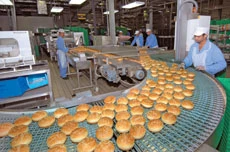
It is the scale of the operation that really takes a visitor’s breath away. The bakery operates 24/7 and produces in one year enough cupcakes that, if placed in a line touching each other, would stretch 21,170 kilometers — roughly New York to Sydney via London. Scrumptious!
Ovens 66 meters long with serried ranks of cakes or pastries parading through in lines checked and adjusted to the millimeter by gleaming stainless steel machines; cooling rooms as big as a three-storey apartment block with gracefully rotating terraced towers of cakes; a singularly wince-making set of needle like injectors plunging into the heart of cooling cupcakes to fill them with hot jam; and of course Kup Kake the Robot — only the second robot in Saudi Arabia and painted a cheerful orange — whose sole job will soon be to place with great accuracy baked cakes onto a moving belt.
On the cupcake line, Goetz explained the application of hygiene. Once a day the machine is flushed and cleaned with detergent, hot water and sterilizer and inspected for cleanliness. “It’s all automatic,” he said. “Humans could not achieve the standards of cleanliness we set.” Indeed, the products are never touched by staff at all unless absolutely necessary and then only with sterile gloves and covers.
Once the bread and cakes leave the bakery, getting them to the stores is a huge logistical exercise. Based in Jeddah, the products are delivered all across the country and the maximum time between baking and delivery to the shelf is one day. Such is the demand for freshness and quality by Al Baik (the well known Jeddah-based fast food chain) that it takes three deliveries a day of sesame seed buns. “It’s the freshest commercially produced bun in the Kingdom,” said Goetz.
Like news, food has a shelf life and if not sold, it is returned to the bakery for disposal. “If returned, we recycle most of it,” said Goetz. “There are some extremely happy camels hereabouts!”
Next time you look at a L’Usine cupcake, spare a moment for semi-Proustian contemplation. That simple ephemeral object embodies the skills and dedication of very committed specialist bakers obsessed with quality and consistency.
The ultimate proof of the cake — or in this case, the cupcake is, as they say, in the eating. Though as well as being an object of desire, it really should be an object of wonder.