
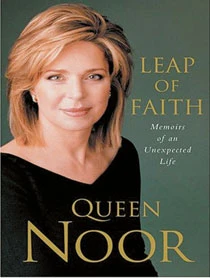
IN the 1980’s, Lisa Halaby’s marriage to King Hussein interested me far more than Princess Diana’s ill-fated union to Prince Charles. I saw the future Queen Noor for the first time in May 1978, during a televised press conference following the announcement of her engagement. I was immediately struck by her grace, poise and reserved intelligence. I can still remember thinking to myself how much I would enjoy reading her autobiography but I never expected to read her memoirs so soon and Queen Noor herself had not planned to tell her story before the end of her “active life.” However, after her husband’s death in 1999, she says that many people encouraged her to share her perspective on her husband’s legacy “at a time when it might be of particular relevance,” especially after the tragic 9/11 events.
Queen Noor has written a moving and captivating account of her personal life with King Hussein while accurately documenting her husband’s ceaseless efforts to bring peace to the Middle East. Brimming with anecdotes and lively details, the book gives us a fascinating insight into the life of a royal couple whose marriage was first and foremost a successful partnership.
Queen Noor tells us that the weeks before her marriage were the “most golden, carefree” of her life despite the immediate changes affecting her lifestyle. For safety reasons, she had to leave her flat for Al Ma’Wa, a small house in the Basman Royal Court compound and whenever she traveled by car, she was followed by a security vehicle. While the press was occupied with discussing the age and height difference between the bride and groom — the king was 16 years older and two inches shorter — her only concern was whether she would be worthy of the faith put in her.
The wedding took place on June 15, 1978 a month after the engagement: “The king and I had little to do with the details of the wedding. Our only directive to the Royal Court was to keep the wedding utterly simple”. The bride wore a very plain white dress and the matching shoes arrived, amid great worry, on the morning of the wedding: “The rest of my wedding day is a jumble of memory fragments: Our struggle to cut the wedding cake — no one had pointed out that the bottom layer was cardboard; our impatience to leave the reception and be alone; and our walk to the front courtyard of the palace and the escape to the airport for our precious refuge in Aqaba.”
During their honeymoon in Scotland, it rained almost every day and the weather was the coldest on record. The couple nearly died as a heater burned out, filling the room with noxious fumes: “Had it started a fire, we would have had no escape route. It was a ludicrous situation. After all the plots and assassination attempts against my husband in his 27 years on the throne, who would ever have imagined that a faulty heater in a friendly country would create such a close call?”
Throughout her life with her husband, she genuinely comes across as having done her utmost to fulfill her commitment to her husband and to Jordan. She found the quasi-permanent lack of privacy extremely challenging but in time, she was able to differentiate between the Western understanding of privacy and personal space and the Eastern emphasis on communal identity and space. She also discovered the negative side of maintaining privacy: Some people would speculate even more when confronted with discretion while others would react to an information black-out by inventing stories and stirring up rumors. She soon realized that everyone surrounding King Hussein considered him and his family public property.
Queen Noor was encouraged by her husband to establish an office. It was the first time anyone in her position established projects and functioned separately from the Royal Court offices: “I would never act independently on issues of political consequence. I ran bold ideas past my husband and, by trying to promote a broader, more open and liberal agenda, raised issues that might not otherwise have come to him. I saw my role as helping to alleviate and complement the burden of responsibility he carried. I did not ask for help or support. I just got on with it, with the help of a growing circle of friends and colleagues.”
The Noor Al-Hussein Foundation manages innovative model projects to fight poverty and encourages individual and community self-reliance as well as the empowerment of women. One of the most successful programs was the establishment of the National Handicrafts Development project aimed at reviving as well as preserving Jordan’s heritage. Queen Noor broke with convention and began wearing traditional dresses at public and official events. These dresses became fashionable again and this renewed interest triggered the establishment of a number of sewing and embroidery projects providing poor women with steady incomes. Queen Noor admits that she has never shown a great interest in fashion and has always been puzzled that a woman in the public eye tends to be judged for her appearance and not her achievements. However, she learned from her husband the importance of body language as King Hussein explained: “If you smile, you give people confidence. If you don’t, they will suspect something is wrong and feel uncertain or worried.”
It is difficult not to be moved by Queen Noor’s deep love and respect for her husband. She also took to heart her new role and throughout her life with King Hussein, she tried her best to be worthy of the trust put in her. She also remained down-to-earth and remarkably humble. During her first official event with her husband, she was moved by the sight of photographs of her throughout the city and also on cars and buses but she very wisely realized that this outpouring of affection was in fact for King Hussein: “I was very touched by it but also conscious that I should not take that affection as an entitlement — I had to earn it in my own right.”
The shock caused by the loss of her husband was tempered by an extraordinary sense of serenity and from that moment, says Queen Noor: “I knew I would never fear death but see it as a chance for reunion. Nothing and no one will ever come close to the love and respect I felt, and continue to feel, toward my husband. His humanity, his constancy, his decency in a world of deceit and self-interest — all these are unparalleled. I continue to thank God for the leap of faith I made as a young woman.”