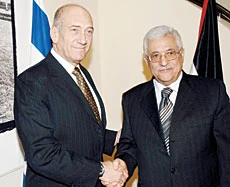
JERUSALEM, 29 August 2007 — Palestinian President Mahmoud Abbas and Israeli Prime Minister Ehud Olmert tackled the biggest issues dividing the two sides at their meeting yesterday — final borders, Jerusalem and Palestinian refugees, an Israeli official said.
It was the first time the two men covered these matters in-depth, the official said.
“These core issues have to be discussed on the way to finding a diplomatic solution of two states for two peoples,” an official in the prime minister’s office quoted Olmert as saying. He spoke on condition of anonymity because the two leaders spoke privately.
Olmert, who has met several times with Abbas in the past few months, has been reluctant to take on these big issues, preferring to focus on general outlines. Israel’s approach has riled the Palestinians, who want to go straight to the core issues of Palestinian statehood.
Heading into the meeting, Abbas warned that an international Mideast peace conference scheduled for November would be a “waste of time” if it failed to address the big three issues, which have stymied peace efforts in the past.
As he entered Olmert’s Jerusalem residence for the meeting, Abbas signed the guest book in Arabic with a wish for peace between the two peoples, the Israeli official said.
The official in Olmert’s office said the two sides hoped by late October to outline a framework for ending the conflict and establishing a Palestinian state. The three major issues will be at the heart of this document, he said.
Neither leader spoke to the press after the talks which Israeli officials described as positive, while the Palestinians remained cautious.
“The president’s position is clear: The aim is to end the 1967 occupation, to establish an independent state on the 1967 borders with Jerusalem as its capital,” chief Palestinian negotiator Saeb Erekat told a news conference.
“All the outstanding issues concerning final status negotiations need discussion. We have not reached the stage of details. We have not reached the stage of drafts,” he said.
“We have not presented the Israeli side with any document and we have not received any such document from the Israelis. We are at the stage of proposals and not negotiations... We don’t want to raise expectations too much.”
“Not allowing refugees into Israel is a matter of principle which we must not compromise over,” Foreign Minister Tzipi Livni told a group of visiting US congressmen, according to her office.
Israeli officials said the Palestinians requested the release of further prisoners, which Olmert promised to consider, although this had nothing to do with the release of Hamas detainees or an Israeli soldier held in Gaza.
Hamas spokesman Sami Abu Zuhri criticized yesterday’s summit, telling AFP: “This meeting will fail 100 percent because nothing good will come out of it.
“The only one to get anything out of it will be Olmert because he is trying to make occupation look good before the world.” Abbas and Olmert last met in the West Bank town of Jericho on Aug. 6 in the first such top-level meeting on Palestinian territory in seven years, and discussed steps toward creating a Palestinian state.
US President George W. Bush has called for a Mideast peace conference, expected to take place in November, to advance a final Israeli-Palestinian accord. Olmert and Abbas plan to meet three times before then, the Israeli official said.
The biggest obstacles in past negotiations have been what the final borders of a future Palestinian state would look like; whether Palestinian refugees from the 1948 war that accompanied Israel’s creation would be allowed to return to their homes along with their millions of descendants; and whether the holy city of Jerusalem could be shared.
A successful outcome of the international conference is far from assured. The violent seizure of the Gaza Strip by Hamas fighters in June created dueling governments, with Hamas ruling Gaza and Abbas loyalists in charge in the West Bank. Olmert, whose popularity plunged after last summer’s botched war against Lebanese fighters, might not have the political clout to make the sweeping territorial concessions a final accord would demand.
Still, prospects for peacemaking have been boosted by Abbas’ expulsion of Hamas, which killed hundreds of Israelis in bombings, from government. And the key players in this drama — Olmert, Abbas and the Iraq-weakened Bush — all appear to be hungry for some kind of diplomatic achievement.
Olmert made it clear to Abbas in their meeting that Israel would break off all peacemaking if the Palestinian leader brought Hamas into his government, the Israeli official said. Hamas, isolated because of its violently anti-Israel ideology and its violent takeover of Gaza, is interested in finding an accommodation with Abbas’ West Bank-based government.
Hamas spokesman Fawzi Barhoum said Abbas’ meetings with the Israeli leader would spell the end of Palestinian aspirations to statehood.
“These meetings work to promote internal strife by distracting Palestinian efforts and hindering the establishment of a political system based on purely Palestinian decisions, far from American-Zionist domination,” Barhoum said in a statement.
The meetings between Abbas and Olmert in recent months are an attempt to boost Abbas against Hamas. This was the first time a major development has been reported, sweeping aside official denials that the issues that have tormented peacemakers for decades were on the table.
Ahead of the meeting, the Haaretz newspaper reported yesterday that the two sides had agreed to set up negotiating teams to advance the talks.
Haaretz said Olmert would insist on adhering to the phased approach of the US-sponsored road map peace plan of 2003, which called for the disbanding of Palestinian fighter groups at the outset and the establishment of a Palestinian state in stages.
The road map foundered shortly after it was presented because both sides failed to carry out initial obligations.
Israeli government spokesman David Baker said the two men also discussed ways to strengthen Abbas’ security forces and plans to convene a committee of Israeli, Palestinian, Egyptian and US security officials to examine ways to stanch weapons smuggling from Egypt.
Olmert told Abbas he would soon present a plan Israeli security officials are drawing up to permit greater freedom of movement within the West Bank, which is restricted by Israeli roadblocks, Baker said.
A joint Palestinian-Israeli economic council will be launched, apparently in October in Tel Aviv, in the presence of Olmert, Abbas and international Mideast envoy Tony Blair, he added.
Fighters in the Gaza Strip earlier yesterday fired a rocket into southern Israel, lightly wounding one man when it hit the bathroom of a house, Israeli officials said.
The attack was claimed by the Al-Aqsa Martyrs Brigades, a group loosely affiliated to Abbas’ Fatah party.