QALA-E-KAZI, Afghanistan, 30 August 2007 — Taleban militants released 12 of 19 South Koreans held for nearly six weeks in Afghanistan yesterday, as part of a deal with Seoul that one Afghan minister warned would embolden the insurgents.
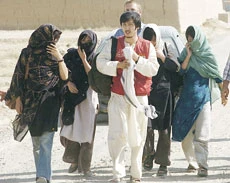
The hostages were released into the care of officials of the International Committee of the Red Cross at three separate locations in central Afghanistan, according to an Associated Press reporter who witnessed the handovers.
The remaining seven will be released over the next 48 hours, Taleban commanders have said. None of the 12 spoke to reporters, who were asked by Red Cross officials not to question them.
The first three women freed arrived in Qala-e-Kazi in a single car, their heads covered with red and green shawls.
Red Cross officials quickly took them to their vehicles before leaving for the office of the Afghan Red Crescent in the town of Ghazni, witnesses said.
Under the terms of Tuesday’s deal, South Korea reaffirmed a pledge it made before the hostage crisis began to withdraw its troops from Afghanistan by the end of this year. Seoul also said it would prevent South Korean Christian missionaries from working in the staunchly Muslim country, something it had already promised to do.
The Taleban apparently backed down on earlier demands for a prisoner exchange. But the militant group, which killed two South Korean hostages last month, could emerge with enhanced political legitimacy for negotiating successfully with a foreign government.
“One has to say that this release under these conditions will make our difficulties in Afghanistan even bigger,” Commerce Minister Amin Farhang told Germany’s Bayerischer Rundfunk radio. “We fear that this decision could become a precedent. The Taleban will continue trying to take hostages to attain their aims in Afghanistan.” A German engineer and four Afghan colleagues kidnapped a day before the South Koreans are still being held.
South Korea’s government, which has been under intense domestic pressure to bring the hostages home safely, said it had tried to adhere to international principles while putting priority on saving the captives.
“I don’t think we made a big deviation from the international community’s principle and practice,” said South Korean presidential spokesman Cheon Ho-sun. “Other countries, when faced with this kind of problem, resolve the problem through contacts with kidnappers. I think there is no exception to this.”
The deal was made in face-to-face talks between Taleban negotiators and South Korean diplomats in Ghazni. The Afghan government was not party to the negotiations, which were facilitated by the ICRC.
The South Korean government and relatives of the hostages have stressed the South Koreans were not missionaries, but were doing aid work such as helping in hospitals.
The Taleban have not stated the reason for their staggered release, and the South Korean government has not publicly objected.
One factor believed to be behind the phased release is that the Koreans have been held in separate groups far from each other in the rugged, mountainous area.
Security may be another reason. Releasing the hostages gradually allows most of the captors to escape while the group still holds some prisoners in case Afghan security forces launch an operation.
Afghanistan has seen a rash of kidnappings of foreigners over the last year. The Italian and Afghan governments were heavily criticized in March for agreeing to free five Taleban prisoners to win the release of an Italian journalist. The head of the Italian aid agency Emergency has said Rome also paid a $2 million ransom last year for a kidnapped Italian photographer — a claim Italian officials did not deny.
The Taleban and South Korea have said money played no part in Tuesday’s deal.
Relatives of the released South Korean hostages, who all belonged to the same church, expressed relief that the ordeal was over.
“I talked to my parents on the phone and they cried and said ‘(our daughter) is coming back alive’,” said Lee Jung-hoon, the brother of one woman released yesterday.
“On the other side of my mind ... I strongly hope that the remaining hostages will safely come back soon as well,” Lee said from South Korea.
The Taleban originally kidnapped 23 South Koreans as they traveled by bus from Kabul to the former Taleban stronghold of Kandahar on July 19. In late July, the militants killed two male hostages, and they released two women earlier this month as a gesture of good will.
The hostage crisis unfolded at a time of soaring violence in the country six years after US-led forces toppled the Taleban government, which had harbored Al-Qaeda leaders before and after the Sept. 11 attacks.