
VULTURES get bad press.
If David Beckham looked like a Lappet-Faced Vulture, which for the human legal vultures out there he does not, then however talented or useful he was he would get bad press too. There we go again! The image of a vulture was used to conjure in the mind the idea that persons involved in assisting errant citizens faced with the majesty of the law are somehow scavengers, feeding on the dead, afflicted or the dying. Clearly they are not; but the bad press that the vulture as a species has received over centuries has associated this rather noble and essential creature with all things nasty.
Perhaps it is because they eat raw dead animals; that might make an interesting topic of conversation over your next blue steak or when absorbing some sushi.
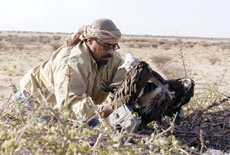
Dr. Mohammed Shobrak is the Lappet-Faced Vulture’s (Torgos tracheliotus) champion in the Kingdom. He has studied them for the best part of 20 years. Indeed, his doctorate was the result of his studies of the bird. In conversation he has the true enthusiast’s delightful knack of dropping intriguing anecdotes about the bird’s family life that seduces the listener into seeing them in an entirely different light.
For example their enormous nests, often built one to two months in advance of laying eggs, are composed of a slew of twigs and branches which gradually increases in diameter from the parent birds maintaining and, as Shobrak says, decorating it. Lined in the center with grass, livestock or camel hair when they can get it, it can reach two meters in diameter. They are usually found in the Kingdom on the flat tops of acacia trees. Entirely un-shaded, the very attentive parent birds will shade the single chick they produce from the glare. Shobrak found that the average time that adults shaded the chick by spanning their wings, was 94.42 seconds at a go.
And the chick consumes, from its 200 grams weight at hatching over the next 120 days to fledging, about 37 kilos of food. Even this early in their lives the bill is noticeably heavy and the lobe-like facial flaps from which the birds get their name are even present at hatching. And, contrary to popular belief, vultures kill and do not just hang about at the Tracheliotus Club — even though they gather at carcasses for, as Shobrak avers, they are a sociable species — waiting for a free lunch. (Forgive me: I just have to deal for a moment here with the counter-intuitive idea of “sociable vultures” chatting to chums, up to their featherless necks in disembowelled goat and clutching a pre-prandial restorative and being, on the whole, entirely unlike tax inspectors.)
Lappets prefer large carcasses, since they provide the most subsistence at a sitting. Indeed, currently they are performing valuable clean-up work on carcasses in the Kingdom where what seems to be a batch of poisoned food — possibly barely — has caused many deaths in the local camel population. However, especially in the hatching season Lappets will also on occasion attack young and weak animals and raid the nests of other birds, perch-hunt hares and other small mammals that have an overdeveloped sense of self-importance brought about by the ill-founded belief that vultures only eat carrion.
It is a big bird. Up to 45 inches (1.2 meters) long, with a wingspan of nine feet (2.35 meters), the Lappet-Faced is one of the largest vultures and powerful enough to fend off a jackal! On average they weigh in at 7.5 kilos although there are records of 12-kilogram specimens. In flight it looks big and square winged. It is easily identifiable from the contrast between the very black-looking plumage contrasting with the white thighs and white bar running across the leading edge of the under-wing (from body to “wrist”) and a naked, pinkish-skinned head. The Hooded Vulture (Necrosyrtes monachus) has vaguely similar markings, but is half the size.
They are the most powerful and aggressive of the African vultures and other vultures usually cede a carcass to them. This is often beneficial to the less-powerful vultures because the Lappet-face, with its formidably strong beak, can rip through tough hides and muscles of large mammals that others cannot cope with. Shobrak says that this is where the real ‘pecking order’ is established and each vulture species on a carcass tends to specialize in eating one part of the animal. Some choose soft tissues, others muscle and some have a diet that consists of 80 percent bone.
This is a significant point to anyone wondering what use these birds are. Clearly, scavenging carrion gets rid of decaying animal matter and sources of disease — but that really is a very human desire and probably depends more on cultural mores than nature. What the vultures do is open up the food source for a whole collection of animals, each with a specific function in the interconnected nature of the great scheme of the environment. Some of those animals perform tasks in the ecosystem that scientists can only guess at; knocking one out of the chain could — and sometimes has — altered the whole balance of an ecosystem as fragile as the desert and backfired on humans.
The NWRC itself performs a function that, to the average person, might not seem immediately useful. Studying animals and their habits and effects on the environment they have lived in and helped mould might have no immediately obvious financial or social use. “Tree huggers”, like vultures, have very often received bad press. That is a result of a short-term view more concerned with providing an easily digestible sound bite than communicating a reasoned fact. Environmental studies and conservation — just like pure research — usually do not yield an immediate financial profit that an accountant can point to. So it goes on the back burner but could easily return and bite us later. An example of exactly this is the decline in commercial fishing stocks in various parts of the world due to the destruction and over-fishing of reefs, which are the breeding grounds and nurseries for the development of larger fish.
To see a huge Lappet-Faced vulture standing solitary and motionless in its natural environment, staring at you with unblinking eyes and entirely at ease with itself is humbling and puts the intruding human firmly in its place. Understanding how its behavior contributes to its form and the way it has developed to occupy its niche perfectly in the hugely complex mechanism of the ecosystem — which includes us — is to get a glimpse of precisely how complex and fragile the whole edifice is. With all that in mind and seeing them up close — yes, they really are beautiful.