
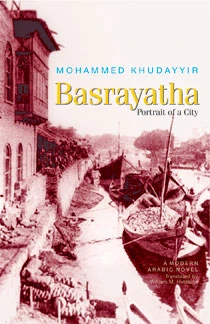
THE Iraqi author Mohammed Khudayyir has written an impressive literary tribute to his native city, Basra. First released in Arabic in 1996 as “Basrayatha: Surat Madina,” the English translation “Basrayatha Portrait of a City” has just been published by The American University in Cairo Press. Basrayatha introduces the reader to the real Basra, a city born out of the writer’s heart and imagination. Line after line, page after page, the reader discovers the soul of Basra through the author’s poetic descriptions, memories and philosophical reflections. At the end, we are left with a larger than life testimony which goes far beyond the sort of portrait we first expected.
When asked why he wrote about Basra, Mohammed Khudayyir answers in with passion: “Basra is my city. I was born and went to school there. I have rarely left Basra. I live in Basra and Basra lives in me. My conscience urged me to write about my native city despite the tragic situation. I have gathered facts and anecdotes from all ages and attempted to recreate in words and memories the places I love such as Al-Zubayr, Umm Al-Brum and Shatt Al-Arab. These places have inspired my short stories and I have never forgotten them.”
In this highly personal rendering of a city, the writer attempts to rediscover his city hidden “beneath a heap of fickle history’s debris and social tragedies.” Khudayyir readily admits that he has used a different philosophy and power of sensation in order to bring light to bear on the life of the city that has caused him to linger as if he were a prisoner within its walls. It is precisely this way of thinking and feeling that permeates the book and leads us inevitably to share Khudayyir’s profound love for Basra: “Saddam Hussein called Basra ‘madinat al-mudun’ that is, the city of cities; I see Basra as the ‘phoenix of cities’. Throughout its history, Basra has died many times but each time it has risen from its ashes like the legendary phoenix, to begin a new life,” explains Khudayyir.
The writer’s feelings for his native city are strengthened during the grueling years of war. During those hard times, he enjoys going to the market “a place that links us to the reality of this historic city more than any other location. There I slip in among the people. (There is nothing warmer or more precious than this word ‘people’.) The congestion in the souk, in these days of war, is pleasant. There is an intimate impression of the warm spirit that unites everyone, the inhabitants of the city’s center and those who come from its outskirts, soldiers, women and loiterers.”
Khudayyir also reflects on the city’s growth and fears that future generations will no longer have the chance to see the old city which is slowly disappearing. He recalls the city’s historic gates which no longer fulfill their purpose; he thinks about the women who no longer wash clothes in the river because they use tap water and electric washing machines and he also ponders on the changing pace of life: “Multi-story buildings, tourist hotels, restaurants, entertainment, venues, business establishments, and firms rise quickly and people immediately master all their attractions. What for us was hard-won knowledge of this city resulting from a cautious, ritualistic series of expeditions into its bowels has today become a normal outing, assimilation, and a crush of humanity engaged in overwhelming, speedy transactions carried out amid a din that rises from every side.”
While observing the changes in Basra, Khudayyir expresses his sadness as he realizes that the tragedy of modern man is that he will no longer build cities according to the plans of ancient ones, “cities that were peaceful, harmonious, and linked to the human soul’s four virtues: Wisdom, courage, temperance and justice.” The exquisite Arabic prose contributes to the beauty of Basrayatha and despite William M. Hutchins excellent translation, one strongly feels that the more poetic passages are better in the original. The eminent Egyptian writer Gamal Al-Ghitani describes Basrayatha as “Scintillating... one of the most beautiful works in Arabic prose about a writer’s human relationship to a time and a place.”
Mohammed Khudayyir has written several collections of short stories, some of which have been translated by Denys Johnson-Davies and which have been included in several anthologies. He was awarded the prestigious Oweiss literary prize in 2004. Khudayyir, who still lives in Basra, was particularly happy with the translation of Basrayatha: “It filled me with hope and proved to me that a literary work can reach the other end of the world.”
At the beginning of Basrayatha, Khudayyir explains that when you write about a city that you know well, you distance yourself from it so it becomes an image, a memory or a distant melody into which all tunes flow in a mysterious way. This touching eulogy of Basra ends with an imaginary concert played at night: “A creative composition... produced by the radiant solitude, the great heart of the night and the night’s spirit, which is packed with hope, life and constancy”.
When the last words have been read, one cannot help but wonder if the author is still content to live in his beloved city plagued by tragedies: “I am simply happy to live in an old city like Basra where the idea of the exotic co-exists with stark reality. I am left with the memories of a city which only exists on the map, a city where life is lost. However, Basra, the phoenix of cities has not yet revealed all its treasures concealed behind the mantle of destruction,” concludes Mohammed Khudayyir.