
JEDDAH, 21 September 2007 — Alia Banaja, a Saudi woman in her mid-20s who is a student in London, said she had to leave Saudi Arabia before she began to think green. “I never heard about global warming (growing up in Saudi Arabia) or our duty as citizens toward our environment,” said Banaja.
“All I ever heard about in high school was stuff about holes in the ozone layer. It was only after I moved to London for my education that I had a profound shift on how I view the world around me, and in particular the environment. I recall how I used to dispose of garbage back home in Jeddah: Paper, plastic, glass, food, metal and anything you might think of, stuffed in a black bag and thrown in a big orange metallic garbage container out on the street.”
In fact, recycling in Saudi Arabia has been going on informally for years. As in many countries, certain segments of the population in the Kingdom sifts through garbage — some even living on or near dumps — to supplement their meager incomes. These people act as de facto recyclers: Grabbing up whatever might have some value, such as recyclable paper waste. Pulling out salvageable paper has a large impact on reducing largest landfill filler; paper is the most common form of garbage.
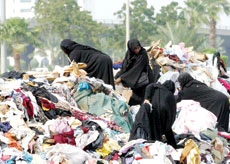
A common sight in Jeddah are the so-called “bin ladies” — usually East African women covered in burquas pushing discarded prams like wheelbarrows to collect recyclables from the ubiquitous orange trash bins scattered around the city.
Trash collectors like these “bin ladies,” as well as municipal garbage collectors (often low-income South Asian workers), garbage hawkers and dump-sifters form the backbone of recycling in the Kingdom. They skim through the dumpsters and separate plastic, metal and paper and in return make some money off of it.
As far as municipal recycling is concerned, the government hasn’t begun to address this issue proactively. On the other hand, among the citizenry there has emerged glimmers of awareness. One such initiative is Mawakib Al-Ajr, a nonprofit organization that manages the large Haraj market in Jeddah’s Industrial City devoted to secondhand items, selling clothing, apparel accessories, furniture, books, magazines and anything a household might otherwise toss to the curb. Proceeds from these sales go to organizations that help orphaned children. Mawakib Al-Ajr also sells some recyclable materials to factories in the area.
“Recycling is not only an environmental responsibility, it is a religious and social responsibility, too,” said Suhaila Baarma, director of the Environmental Department at Mawakib Al-Ajr. The lack of information on recycling processors in the Kingdom is a challenge, she added.
“When I first took charge of the Environmental Department I had to search in the local Yellow Pages for companies that were willing to buy used materials, like metal, glass and plastic,” she said. “And it took me a couple of months to find companies that wanted to recycle.”
Another nonprofit group called Nabta, founded and managed by Doaa Alim, Sawsan Alim and Anwar Abulkher specializes in educational awareness, having developed a curriculum for students at the primary and high school levels. The curriculum includes workshops and real-life activities on recycling, pollution and water and energy conservation. The curriculum has already been taught at different places, including Future Experts Center’s summer program for children and teens in Jeddah last year.
In February 2007, both Mawakib Al-Ajr and Nabta participated at the Art Week at Al-Basateen Commercial Center in Jeddah guiding and instructing youths on the basic guidelines of recycling, like separating plastic, glass and cans.
“I was very eager to recycle, and once I knew about Mawakib Al-Ajr, I immediately started recycling,” said Rozana Al-Banawi, a 24-year-old campaigner of environmental causes. “From the first minute of recycling my family and I were so motivated, and by recycling at home we were setting an example for other people to imitate and we were spreading awareness that recycling is so easy, practical and simple. I have been sharing my recycling experience with many people to prove that we can make a difference if we start with our own selves.”
Without a municipal infrastructure, however, it is difficult for average citizens to participate in recycling programs. Whatever government recycling program would be initiated would likely be patterned on similar program in North America and Europe, where recyclable materials must be separated by consumers, placed in separate containers and passed on to public or private recyclable-waste collectors.
Without this system in place, separating recyclables amounts to little more than a courtesy to informal trash pickers, saving them the trouble of sifting through useless trash to find the recyclable materials. “Fifteen years ago, a group started a recycling program in Saudi Aramco,” said poet Nimah Nawwab. “We used to take our papers and plastic bottles to certain collection points; later on, the bins began to be available in well-known locations as the program advanced and for many years, we have had recycling bins in offices. Committing to recycling depends on people — be they Arab or Western — some do it and some don’t, like anywhere else.”
Baarma said that targeting the newer generations of Saudis and expatriates in the Kingdom is the most important step to raising environmental awareness. “I feel strongly that there will be a great shift in environmental awareness in Saudi Arabia,” she said. “And since there is domestic and international pressure on Saudi Arabia, things will change hopefully for the better.”
Baarma is convinced that recycling programs are vital to sustain our planet’s natural resources. “Mother Earth bears its fruits to benefit humanity,” she said. “But with the way we have been producing, consuming and wasting, we will need at least several more Earths to sustain us.”

