BEIRUT, 26 September 2007 — Lebanon’s Parliament yesterday adjourned for four weeks a crucial session to elect a new president for lack of a quorum and to allow more time for MPs to reach agreement on a consensus candidate.
“Today’s session has been adjourned to Oct. 23 at 10 a.m. for lack of a quorum,” Parliament Speaker Nabih Berri said in a statement shortly after lawmakers were to convene for the first time in nearly a year.
A two-thirds majority of the 127-strong Parliament is required for a candidate to be elected by Parliament in the first round of voting to replace the current pro-Syrian President Emile Lahoud, whose term ends in November.
In the event of a second round a simple majority suffices.
Most of the 58 MPs from the Hezbollah-led opposition boycotted yesterday’s session on the grounds that the feuding political parties had failed to agree on a consensus candidate to replace Lahoud.
“We hope to reach an agreement in the next few days and weeks so we can have a quorum,” said Hezbollah MP Hussein Hajj Hassan. “The ball is now in the court of the ruling majority.”
MP Samir Frangieh, a member of the Western-backed ruling coalition which has 68 votes in the legislature, made clear that his camp planned to go ahead with a vote when lawmakers reconvene in October even if no agreement is struck.
“We are giving negotiations a chance until the next session on Oct. 23, but this is the last chance as during that session we will go ahead with a simple majority vote if there is no agreement,” he told AFP.
However presidential candidate Michel Aoun, who heads the opposition Free Patriotic Movement, warned against any attempt by the majority to force through a vote.
“Our message is clear: The election by a simple majority would be a declaration of war,” he said.
“The issue of the legal quorum is not open to discussion, and countries that back such a president (elected by a simple majority) will have to dispatch troops to protect him.” Although Berri had summoned rival factions to convene yesterday, it was clear beforehand that an actual vote would not take place because of the deadlock.
Berri nonetheless has voiced optimism that Lebanon’s divided parties would strike a compromise by Nov. 24, when Lahoud’s term ends.
The lawmakers arrived at the Parliament building in central Beirut under tight military escort, many from a nearby luxury hotel where they had been staying for security reasons.
The perimeter around Parliament was off-limits to traffic with elite troops and tanks deployed throughout the capital.
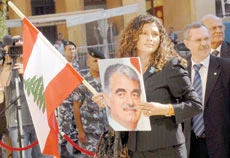
Several MPs from the ruling coalition briefly held up a banner bearing the names and pictures of six fellow lawmakers killed since 2005 in attacks they have blamed on Syria.
The latest victim, Antoine Ghanem, was assassinated last week in a car bombing.
Portraits of the MPs killed and Lebanese flags were also placed on the seats normally reserved for them.
Ghanem was the eighth anti-Syrian politician to be assassinated since the 2005 murder of five times Prime Minister Rafik Hariri, a killing that led to massive protests and put an end to nearly three decades of Syrian domination.
Prime Minister Fouad Siniora’s government has been paralyzed since opposition forces, which include factions backed by Iran and Syria, withdrew their six ministers from the Cabinet in November 2006 in a bid to gain more representation in government.
Siniora’s allies are determined to install an anti-Syrian in the presidency, hoping to end one of the last vestiges of Damascus’ political control in Lebanon. But Hezbollah and its allies in the opposition have vowed to block any candidate they don’t approve — and yesterday they followed through on their threat to prevent the two-thirds quorum of the 128-seat legislature required for a vote.
When a Parliament official rang a bell three times to call lawmakers into session, the 68 members of the government coalition were in the chamber, but most opposition members stayed out in the hallways. Both sides quickly began talks to try to find a compromise candidate.
For the first time in months, Berri met with Saad Hariri, leader of the largest anti-Syrian bloc. Hariri described the meeting as “positive,” saying he will continue contacts to reach an agreement on the election of “a president for all the Lebanese.” In the Parliament building, where a session has not been held for months because of the political deadlock, the atmosphere was generally amicable, with lawmakers from both camps hugging and chatting. But tempers remained high.
Ahmed Fatfat, a Cabinet minister from the majority, warned that the next session would be decisive, repeating threats that if the opposition boycott continues, the pro-government majority will hold a vote without quorum and approve their own candidate.
“If no consensus on a president is reached, the majority will elect a president,” Fatfat told The Associated Press as he was leaving the Parliament building. “We will not accept the presidency to be left vacant.” Walid Jumblatt, a leading member of the majority, was more hard-line. “I don’t believe in dialogue with murderers,” he told AP Television, referring to those in the opposition allied with Iran and Syria.
Government supporters accuse Syria of seeking to end the ruling coalition’s small majority in Parliament by killing off lawmakers. They warn of a “new war” by Syria to undermine Lebanon.
Three pro-government figures and one opposition member are among more than a dozen candidates vying for the presidency, which under Lebanon’s sectarian power-sharing system must go to a Maronite Christian. Attempts to find a compromise have been difficult, with few prominent figures seen as neutral — though army chief Gen. Michel Suleiman has been touted by some as a possibility.
If the Parliament cannot elect a president by Nov. 24, Siniora and his Cabinet would automatically take on executive powers. If that happens — or if the ruling coalition forces through their own choice — the opposition is urging Lahoud to appoint an alternative government before he leaves office.
That could result in two rival administrations, a grim reminder of the last two years of the 1975-1990 civil war during which army units and the public administration split up. France said yesterday it hoped the rival parties would reach agreement by Oct. 23 and pick a head of state who enjoys widespread support.