
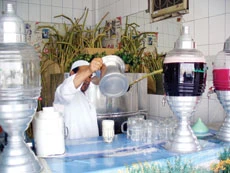
IFTAR tables in Saudi Arabia always contain popular local beverages like gamar al-din (berry juice), subia (a drink made from raisins or bread), laban (yogurt drink), and Arabic coffee. Some may not be aware that sugarcane juice has also become a seasonal treat at the Ramadan breakfast (iftar) table.
“I’ve worked in this shop for 11 years,” said Abu Emad, an Egyptian merchant who owns a shop in Riyadh’s Al-Bathaa district that sells sugarcane and its derivatives.
“The demand for sugarcane juice has been steadily increasing. Most of the customers had been expatriates, especially Egyptians, as it is a very popular drink in Egypt. Now over a third of my customers are Saudis.”
Abu Emad estimated that he sells about 400 glasses of sugarcane juice a day during Ramadan, up from about 80 glasses on regular days.
“Customers usually start coming in after Asr prayer,” he said as he was running the cane through a juicing machine he had imported from Egypt. The juice dribbled out of a hole at the bottom of the machine into a jug immersed in ice. “When the customer comes I squeeze the sugarcane sticks in front of him then I put it in a plastic container: 10 riyals for two liters.”
“Indian and Pakistani usually add some black salt to give the juice a slightly savory flavor amid the sweetness,” said Anwar, who was waiting for Abu Emad to finish squeezing his cane. “I’ve noticed that Egyptians and Saudis tend to add some lemon juice to it.”
Abu Emad proceeded to extol the benefits of sugarcane juice and how the beverage has been around since the time of the pharaohs in Egypt: “They used to give sugarcane juice to the laborers when they were building the pyramids,” he said.
Sugarcane juice is, of course, quite sugary and drinking it can cause complications with people who are diabetic. (Diabetes is a large and growing health problem in Saudi Arabia.) Nevertheless, Suliman Al-Sherada, a diabetic Saudi, said he’s willing to take the risk from time to time.
“I learned about this marvelous drink five years ago through an Egyptian friend who recommended it,” he said. “I wish if I could find sugarcane shops in other districts of Riyadh. During Ramadan I come to Al-Bathaa specifically to buy sugarcane juice”
Hassan Al-Malki, a Saudi citizen who was wandering around the shops of Al-Bathaa, said he’s never tried sugarcane juice because he’s skeptical about the hygiene of the stalls that sell it. “These shops give me the impression they are not abiding by hygienic standards, that’s why I avoid them,” he said.
Sugarcane is found in tropical and sub-tropical Arabic countries, mostly in North Africa. Sugarcane, the most common source of sugar (which can also be extracted from sugar beets that grow in colder climates), also grows in the tropical and sub-tropical climates in Saudi Arabia, Yemen and Oman.