MAKKAH, 28 September 2007 — There are reasons to suspect that every foreigner coming to Makkah in ihram is not a pilgrim. Several poor foreigners are lured by the prospects of the profitable trade of begging in the holy city, particularly in the month of Ramadan.
In most cases, these beggars are not ready to leave the Kingdom after the expiry of their visas and eventually end up in the detention centers run by the Anti-Beggary Department. Authorities have occasionally found entire families, including small children, earning a lot of money through this loathsome trade.
The matter becomes horrifying when some gangs resort to the mutilation of healthy children in order to make them effective beggars. It is suspected that there are criminal gangs who buy or hire children from poor countries to force them to beg in the holy cities.
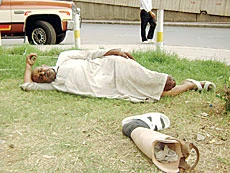
In a visit to the Misfala district in Makkah, Arab News found a 60-year-old Arab man in a small park not far from the Anti-Beggary Department office. His artificial leg had been removed so that passersby could see clearly the crude stump of his bare amputated leg.
“I am hungry. I came here with my daughter from a neighboring country on the first day of Ramadan. A few days after our arrival I lost my way. I don’t know where my daughter is. I don’t know what to do without her. Can you help this poor old man,” he replied stretching his hand apparently for some money.
I assured him that I could help him find the missing daughter by taking him to the nearest police station. On hearing the word “police” the man shrunk back saying it was no use and he could manage without the police. “I am very tired and cannot move an inch,” he said.
When I asked him why he was sitting in the hot sun, he said he would move to the shade when the heat was too much. Then I left him and watched him from a distance. I found him drawing the attention of passersby and receiving money from them.
A detained beggar at the Makkah Anti-Beggary Department jail, Ibrahim Qaid of Yemeni nationality, said he and several others crossed the mountainous Saudi-Yemen border with the help of a smuggler. The smuggler took them to Makkah for a huge fee. “Unfortunately, two days after our arrival in Makkah I was arrested while begging,” he said. He is now awaiting deportation.
Mansour Al-Hazmi, director of the Anti-Beggary Department in Makkah, said that about 98 percent of beggars were foreigners of various nationalities. Some of them are legal residents while others are overstayers.
“There are several families who send their children for begging. There are also organized groups who bring in children from poor countries and disfigure them for begging,” Al-Hazmi said, adding that begging usually peaks in Ramadan — a time when people are usually more charitable.
Muhammad Shafi, chairman of the Joint Committee to Combat Begging, said: “The begging gangs are very active in the holy month because it is a time when they are able to earn huge sums. There are organized networks of gangs that arrange for beggars to enter the Kingdom. They also plan their activities, including mutilating them in order to evoke the pity of onlookers.”