ISLAMABAD, 29 September 2007 — The Pakistan Supreme Court yesterday dismissed legal challenges to President Gen. Pervez Musharraf seeking re-election, clearing the main hurdle to his bid for another five years in power.
Musharraf, a close US ally, appears set to become a powerful civilian ruler after the Oct. 6 vote, despite increasingly bitter opposition and dwindling popularity after the 6-3 court verdict in his favor.
The court dismissed petitions filed by opposition parties and lawyers arguing that Musharraf was ineligible to run because he had retained his army post. The ruling triggered jubilation in the government and anger among the opposition, which vowed to keep fighting to sideline Musharraf.
Presiding over the nine-member larger bench, Justice Rana Bhagwandas gave only a cursory explanation for yesterday’s ruling which drew howls of protest from black-suited lawyers in the gallery of the packed, cavernous courtroom. Six of the nine judges believed the issues raised in the petition did not fall within the court’s jurisdiction.
“These petitions are held to be nonmaintainable,” Bhagwandas said, prompting the lawyers to chant “Shame, shame!” and “Go, Musharraf, go!” Justices Bhagwandas, Raza Khan and Shakirullah Jan were the dissenting judges.
Musharraf, who seized power in a 1999 coup, has faced growing political opposition since his failed attempt to oust Pakistan’s top judge in March. He is also struggling to contain growing militancy and growing public sentiment that his alliance with Washington has fanned extremism.
But he has tried to retake the initiative in recent weeks. The general has pledged to doff his uniform if he wins the election and so restore civilian rule in a country that has lurched between unstable elected governments and military regimes during its 60-year history.
At the same time, he has clamped down on his most vociferous opponents. Authorities this week rounded up hundreds of opposition activists to prevent protests, though the Supreme Court on Thursday ordered them freed.
The government has insisted all along that Musharraf is a qualified candidate, and declared the ruling a milestone on Pakistan’s path back to democracy. “Justice triumphs,” presidential spokesman Rashid Qureshi said.
Talat Masood, a prominent Pakistani political analyst, said Musharraf’s insistence on securing re-election before quitting the army showed how real power still resides with the military.
While the court ruling will further polarize Pakistan’s politics, there is no sign that its weak, bickering opposition parties can mobilize widespread resentment at the continued dominance of Musharraf and the army.
“It looks as though the country is very much divided at the moment, and they have been successful in doing that and are able to hold on to power,” Masood said.
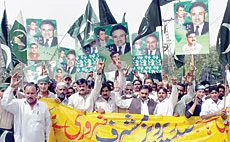
About 100 supporters from an Islamist opposition party threw tomatoes and eggs at the court’s front gate as they chanted slogans against the president. Police kept them separated from about 100 Musharraf supporters.
Farid Piracha, a lawmaker for the Jamaat-e-Islami party which had filed one of the petitions, refused to accept the decision.
“The judges have not fulfilled their constitutional obligation,” Piracha said. “Now our fight will be on the streets...This decision does not reflect the sentiments of the people, and it will not be accepted.”
Javed Hashmi, acting leader of PML(N) party, said their lawmakers would resign from Parliament — an opposition strategy aiming to rob the election of legitimacy.
Today, the Election Commission is due to assess the eligibility of the 43 presidential candidates. The main challenger to Musharraf is likely to be retired Justice Wajihuddin Ahmed, nominated by lawyers.
Makhdoom Amin Fahim, vice chairman of ex-Prime Minister Benazir Bhutto’s Pakistan People’s Party, was also nominated but the party has said he would only run if Musharraf was disqualified.
Benazir is still holding out hope of a power-sharing deal with Musharraf after parliamentary elections due by January.
After yesterday’s ruling, Benazir told Geo TV that her party could join the other opposition groups in resigning from the assemblies if Musharraf did not move toward restoration of democracy.
Benazir, who plans to return next month from self-exile, wants an amendment in the constitution that would allow her to serve a third term as prime minister if elected.
— With input from agencies