
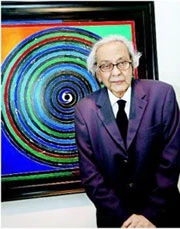
GORBIO, France, 8 October 2007 — Inhabitants of a picturesque French village overlooking the Mediterranean are bitterly divided over how to respond to a bequest from one of India’s most famous living artists.
Syed Haider Raza, 85, who has lived in France since 1949, has offered to leave his personal collection of paintings to the municipality of Gorbio, a mediaeval village near the Italian border which he has made his adopted home.
“It is a gift in order to thank the people of Gorbio for all the happiness they have given me,” Raza told Le Journal du Dimanche newspaper yesterday.
However the offer has been blocked because members of the village council object to the conditions which the artist has attached.
Before agreeing to the legacy, Raza is insisting that his works be put on display for four months every summer in the tower of Gorbio’s castle — and this for the next half century.
“But who’s to say that in 50 years the people of Gorbio won’t be utterly tired of his paintings?” said village Councilor Michel Fevrier.
Born in Babaria in the central Indian state of Madhya Pradesh in 1922, Raza was a founder member of the Mumbai-based Progressive Arts Group before leaving to study at the Ecole Nationale des Beaux-Arts (National Fine Arts School) in Paris.
Originally focusing on expressionist landscapes of the French countryside, his style shifted over the years and he now paints colorful abstracts in oil and acrylic, often inspired by Indian mysticism.
Last year a 1972 painting “Forest of meditation” sold at Sotheby’s for $1.47 million (1.03 million euros), and in September a retrospective of his work marking his 85th birthday received critical acclaim in New York.
Raza was married to French artist Janine Mongillat, who died in 2002 and is buried in Gorbio. Her works also feature in his personal collection alongside pictures by Vasarely and Sonia Delaunay, as well as mediaeval Indian sculptures and miniatures. Altogether it is valued at 10 million euros.
According to Le Journal du Dimanche, Raza has offered to pay 900,000 euros to insure his collection and to set up a foundation, but he insists that they be installed in the 12th century Tour Lascaris, the village’s main tourist attraction.