
JEDDAH, 14 October 2007 — Here follows the traditional Eid story:
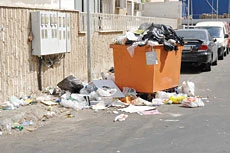
Jeddah’s bulging bins are once again providing rich pickings for the feral felines of the city and offering a rich breeding ground to flies and disease. Despite the Baladia’s best efforts, the huge amount of waste generated by the apparent feeding frenzy in reaction to a month of theoretical abstemiousness — coupled with the short holiday for many government organizations and businesses allowing people to stay at home and refuel — has strained the capacity of the collection services a dumpster too far.
The result of the overflow is a littoral of litter around the orange islands of dumpsters in the side streets of the city. Responsible citizens may try to dump their garbage in a bin, but if it is full the rubbish finds its way to the adjacent pavement through gravity or frustration. If neither of those do it, the morsel-mining cats will usually do the job.
However, the results of a one-hour drive and inspection of 100 orange bins show a somewhat different picture.
A survey in the Al-Rawda and Al-Salama districts of Jeddah between 9 a.m. and 10 a.m. yesterday revealed a very pleasing surprise: Only eight percent of the dumpsters had full loads of garbage, two of those had the traditional litter around them. Just one — and it was empty — had a rather indignant cat perched on the edge; it was clearly concerned at the lack of nourishment.
Does this indicate a permanent change in the quality of the garbage collection?
The demographics of Jeddah seem not to have got ahead of the game. Greater than the national population increase of about four percent per annum, Jeddah’s seven percent or so — boosted by migration to the city from the rural areas — has strained the system.
However it appears that the contractors emptying the garbage are — at least from the evidence gathered yesterday morning in the two residential areas investigated — are up to the mark.
On July 17, 2004 the municipality announced the first move to phase out the thousands of orange garbage skips that have become a feature of the Jeddah streetscape and announced the launch of a new household garbage-collection program.
The then deputy mayor for services, Waleed Abdulaal, announced the start of pilot schemes to collect household garbage from individual premises rather than from street corners.
“There are several reasons for the change,” Abdulaal said at the time. “Using securely tied garbage bags and daily collection will reduce the potential for disease, the breeding environment for insects and rodents and free up road space.”
With daily collection, the garbage was supposed to be on the street for less time and produce several improvements: The reduction of the chances of attack by the city’s huge population of feral cats; the beginning of the end for Jeddah’s trash sorters who rummage through the skips to remove saleable clean cardboard and aluminum cans and the reduction of a vector for the spread of disease.
The cats are still rummaging; the trash-sorters are still out in force and now with a relatively new feature, male scavengers as well, and the garbage is still very much in evidence.
The orange bins are still very much in evidence — and still provide the sources of food, infection and finance they traditionally have. But if the municipality maintains the punctiliousness in emptying them that our short survey seemed to demonstrate, it is a positive move.
We will keep a watching brief to ascertain if this was a flash in the bin, so to speak.
There are health and environmental hazards posed by having open garbage skips in Jeddah’s climate and with a rapidly increasing population compounding the problem, the health and welfare of city residents had to come first.
Abdulaal inclined to the thought that attitude change to the disposal of domestic waste was the goal to aim at.
“By encouraging people to put their waste in bags and place them outside their residences for collection actually involves them in the disposal process to a greater degree,” he said. “We can move mountains, but it takes far longer to change people’s habits. It is an education process that will take time.”

