
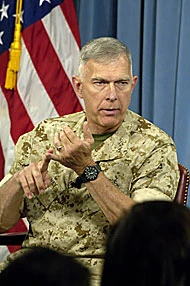
WASHINGTON, 17 October 2007 — The US Marine Corps’ top commander is concerned about the ability of the Marines to respond to security flare-ups around the world on short notice.
Commandant General James Conway says the Marine Corps’ ability for rapid response to crisis outbreak worldwide has been tempered by the strain of the Iraq war.
Conway also agreed with recent assessments that Al-Qaeda in Iraq is significantly crippled by recent US efforts, but added the terrorist network has shown previously an “amazing ability to regenerate.”
He cautioned that his view was restricted to the western Anbar province, where Marines have control. “Are they crippled? Yeah, but not destroyed,” he said. “Are they still dangerous? Absolutely.” The Marine commandant also said he doesn’t want to see Iraq “divided into factions — the strength of the country is in staying together.” In recent years Conway said the Marines have become a “second land army” responsible for securing Iraq. He says they’ve had to buy heavy equipment, including a fleet of 3,700 MRAPs, or Mine Resistant Ambush Protected vehicles, to protect its personnel from roadside bombs.
“I’m a little bit concerned about us keeping our expeditionary flavor. ...We are much heavier than ever before,” he said Monday at a lunch sponsored by the Washington-based Center for New American Security. Although hugely successful at deflecting roadside bombs, Gen. Conway said the MRAPs weigh over 40,000 pounds. “You can’t fly them in on helicopters; you can’t even put them on ships. This is a conundrum for the expeditionary forces, because to be expeditionary, you must be light.” Conway’s comments come amid discussion at the Pentagon that the Marines pull its forces from Iraq and send them instead to Afghanistan to take the lead combat role there, although Conway declined to comment because he said he had not yet briefed Defense Secretary Robert Gates.
The realignment idea became public last week in a New York Times story. Military experts have suggested in recent weeks that the Marine Corps’ role as an expeditionary fighting force may be better served in Afghanistan. Due to recent successes in getting Iraq’s Sunni tribal sheikhs to work with Marines in Anbar that lead to a reduction the level of violence, military experts have re-examined the role of the Marine Corps in the war on terror — which is providing some of the force behind Conway’s proposal to leave Iraq in the hands of the army.
When word of Conway’s proposal emerged last week, Defense Secretary Robert Gates hastily labeled the proposal as a matter in its infancy and said that no transition plans were being drawn up. But last Friday, Conway told reporters that he was serious about the discussion that would move his forces out of Iraq’s Anbar province, where violence has waned in recent months and where 11,000 Camp Pendleton troops are scheduled to deploy at year’s end.
Both Conway, and Lt. Gen. James Mattis, who heads the California-based 1st Marine Expeditionary Force, have quietly touted for weeks the benefits of having the Marines focus on Afghanistan and the army concentrate on Iraq. Currently, there are no major Marine units in Afghanistan. In Iraq, the army has taken the combat lead, while the Marines have handled Anbar province, a largely desert region. Officials who support the realignment said Afghanistan’s environment better suits the Marines’ highly mobile forces and versatile combat skills. They also contend that it would allow the corps and amy to operate more efficiently and thus better maintain troop quotas for two wars that have strained the forces. “We are the premier expeditionary force in the world, and operations in Afghanistan would take advantage of what we do best,” Lt. Col. Chris Hughes, chief spokesman for the 1st Marine Expeditionary Force, told reporters last week.
“This (Afghanistan) mission would be very much in line with our charter,” Hughes said.
Dan Goure, vice president of the Lexington Institute, a nonprofit think tank in Arlington, Virginia, said the Marine Corps might be trying to wiggle out of the politically controversial Iraq war and take on a prominent role in the more widely accepted and clearly defined mission in Afghanistan.
“The Marines have done a splendid job in Iraq, but they are being overshadowed by the army. That has to be on their minds,” Goure recently told reporters. “I think they want to go to Afghanistan to highlight some of their unique capabilities and show their relevance for the kind of wars we are likely to fight in the future.”

