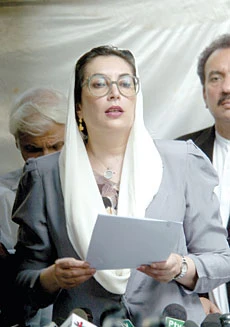
KARACHI, 20 October 2007 — Defiant former Prime Minister Benazir Bhutto vowed yesterday that she would not give in to the militants whom she blamed for an assassination attempt against her — a suicide attack that killed up to 138 people and dampened her long-awaited return to Pakistan.
Benazir, wearing a black armband to mourn the victims, said there were two attackers in the deadly bombing, and that her security guards found a third man armed with a pistol and another with a suicide vest. Ahead of her arrival, she said, she was warned suicide squads had been dispatched to kill her.
“There was one suicide squad from the Taleban elements, one suicide squad from Al-Qaeda, one suicide squad from Pakistani Taleban and a fourth — a group — I believe from Karachi,” she said.
Baitullah Mehsud, a top militant leader on the unstable Afghan border, threatened this month to meet Benazir’s return to Pakistan with suicide attacks, according to local media reports. An associate of Mehsud, however, denied Taleban involvement.
Benazir said her guards prevented more carnage. “They stood their ground, and they stood all around the truck, and they refused to let the suicide bomber — the second suicide bomber — get near the truck,” she said.
Benazir blamed militants for the attack. “We believe democracy alone can save Pakistan from disintegration and a militant takeover,” she told a news conference. “We are prepared to risk our lives and we are prepared to risk our liberty, but we are not prepared to surrender our great nation to the militants.”
She did not blame the government, but said it was suspicious that streetlights failed after sunset Thursday when her convoy was inching its way through the streets of Karachi. She said the phones were down, making it difficult to have the lights restored.
“I’m not accusing the government, but certain individuals who abuse their positions and powers,” she said. “We were scanning the crowd with the floodlights, but it was difficult to scan the crowds because there was so much darkness.”
She said telephone numbers of suicide squads had been given to her by a “brotherly” country and she alerted President Gen. Pervez Musharraf in a letter dated Oct. 16. Benazir claimed the next attack against her would target her homes in Karachi and her hometown of Larkana, using attackers posing as supporters of a rival political faction.
She said she was confident the government would take measures to prevent it. Benazir said the militants had “gained strength” but that the deteriorating security situation in Pakistan should not delay elections — slated for January.
Benazir defended her decision to negotiate with Musharraf, who seized power in 1999, saying it was aimed at a transition to democracy. “We believe democracy alone can save Pakistan from disintegration and a militant takeover,” Benazir said.
The attack was one of the deadliest in Pakistan’s history. Ghulam Muhammad Mohtarem, the top security official in Sindh province, suggested Benazir’s camp got carried away by celebrating her return after eight years in exile, and had not taken the need for security seriously.
Benazir, however, said she accepted the risks. Surviving the attack unscathed, the back-to-back explosions went off near a bulletproof truck that was carrying her and top party officials.
Just 10 hours after landing in Pakistan, her jubilant homecoming parade turned into a scene of blood and carnage, ripping victims apart and hurling a fireball into the sky. Benazir narrowly escaped the attack, which shattered the windows of her truck. She said when the first bomb exploded, she was resting her feet in the middle of the bus.
Her procession had been creeping toward the center of Karachi for 10 hours, as supporters thronged her truck, when a small explosion erupted near the front of the vehicle. That was quickly followed by a larger blast, destroying two escorting police vans.
The attacker’s head was found nearby and taken to a forensic lab to try to identify him, police officer Manzoor Mughal told The Associated Press.
In the aftermath, bodies lay motionless in the street among pools of blood, broken glass, tossed motorcycles and bits of clothing. Some of the injured were rushed on stretchers into a hospital, and others were carried by rescuers in their arms.
Musharraf phoned Benazir yesterday to express his shock and grief, and prayed for the former premier’s safety and security, his spokesman said.
“The president and Benazir both expressed their unflinching resolve to fight this scourge of extremism and terrorism. They also agreed that there was a need for the entire nation to unite in order to rid the country of this menace of suicide bombings, terrorism and extremism,” Rashid Qureshi said.
There was no claim of responsibility for the attack, which cast a shadow on Benazir’s talks with Musharraf and possible plans for a moderate, pro-US alliance.
Mohtarem said it was the nuts, bolts and steel balls packed around the explosives that had made the bomb so deadly. He said it was impossible to prevent more such attacks. Officials at six hospitals in Karachi reported 138 dead and around 250 wounded.
Karachi police chief Azhar Farooqi said that 113 people died, including 20 policemen, and that 300 people were wounded. It was not immediately possible to reconcile the different death tolls.
Police collected forensic evidence — picking up pieces of flesh and discarded shoes — from the site of the bombing. Benazir’s truck was hoisted away using a crane. One side of the truck was splattered with blood and pocked with shrapnel holes.
On the eve of Benazir’s arrival, a provincial government official had cited intelligence reports that three suicide bombers linked to Mehsud were in Karachi. The local government had also warned Benazir could be targeted by Taleban or Al-Qaeda.
Karachi, which lies in the far south of Pakistan but has been buffeted by militant attacks in recent years, was quiet yesterday. Schools were closed and traffic was thin, with city residents wary of venturing out.
Unrest broke out in two districts but did not appear serious. Hundreds of Benazir supporters hurled stones at vehicles and shops during a funeral procession for two victims, forcing police to cordon off the area.
Elsewhere, Benazir supporters ordered shops to close and burned tires on the road.
Benazir had flown home Thursday to lead her Pakistan People’s Party in January parliamentary elections, drawing cheers from crowds that police put at 150,000. She has ambitions to win a third term as prime minister. The throngs reflected Benazir’s enduring political clout, but she has made enemies of Islamic militants by taking a pro-US line and negotiating a possible alliance with Musharraf.
It remained unclear what impact the attack could have on reconciliation efforts between the two rivals: Whether it could stiffen their resolve to fight militancy together or strain already bad relations between Benazir and the ruling party supporting Musharraf.
Benazir’s husband, Asif Ali Zardari, told Dawn News television he suspected that “elements sitting within the government” who would lose out if Benazir returned to power were involved in the attack. In the past, Benazir has accused conservatives in the ruling Pakistan Muslim League-Q party and the security services of supporting religious extremists. Benazir had paved her route back to Pakistan through negotiations with Musharraf.
Their talks yielded an amnesty covering the corruption charges that made Benazir leave Pakistan. Musharraf won re-election to the presidency in a vote this month by lawmakers that is being challenged in the Supreme Court.
— With input from agencies