
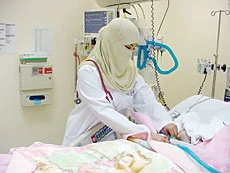
DAMMAM, 20 October 2007 — Following a recent episode about Saudi nurses on the popular Ramadan comedy series Tash Ma Tash, a number of nurses spoke to Al-Madinah newspaper about the social stigma they face working as nurses and the type of opposition they face from their families.
Some Saudi nurses say that following the episode, which satirically took a look at the profession, opposition has increased. Exasperated by the situation, they are now calling on wider society to change its perception.
Nora Ahmad, a nurse employed at Dammam’s central hospital, said, “After the Tash Ma Tash episode my brothers and family started to ask questions about my work. I sometimes have to work night shifts and they asked me to move to another hospital where I would only have to work during the day.”
Umm Abdullah, a nurse at a maternity hospital in Dammam, said, “The Tash Ma Tash episode was terrible. After watching the show, my husband asked me to move to a health center that only opens during the day. I think it’s an honor for me to work in such a profession. I strongly believe the wider society needs to change its perception.”
Umm Abdullah added, “I don’t see a difference in working during the day or night as long as I am working. It’s all the same. Some men are just overprotective.”
Seba, an anesthetist at Dammam Hospital, said she has faced opposition to her work since she first began studying to become a nurse.
“Society looks down on nurses and maids. That’s because nurses work almost 12 hours per day in a mixed environment and also because they are often required to work night shifts,” she said.
One Saudi nurse in Dammam, who asked her name not be published, said she has been working as a nurse for 10 years now.
“I have always experienced social stigma and continue to do so. I faced a lot of obstacles and troubles at the beginning of my career. My family initially refused to accept the fact that I was working as a nurse and considered it to be a disgrace. They said I should instead become a teacher. Most Saudi women prefer to work as teachers because the hours are socially acceptable and there is no gender mixing,” she said.
Mona Al-Hagary, an obstetrician, said, “Saudi society doesn’t encourage women to work in the nursing field due to certain intimate social reasons. Nurses are required to carry out doctor’s orders and are responsible with keeping patients clean.”
Al-Hagary added that in previous times women in the Arabian Peninsula would act as nurses during wartime. “During the Prophet’s time, women used to take care of wounded people during wars. They acted like nurses. However, people’s perceptions have changed. I wonder why this is,” she said.
“In the history of Islam women were allowed to work as nurses and there are a lot of excellent examples of nurses in the time of the Prophet Muhammad (peace be upon him). ... Women would take care of the sick and the wounded especially,” said Al-Hagary, adding that Saudi nurses constitute only five percent of the total 70,000 nurses in the Kingdom.

