
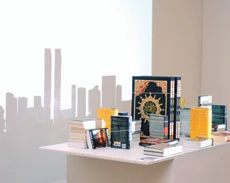
SOTHEBY’S held the first sale of Modern and Contemporary Arab and Iranian art in London on Oct. 24th. About 85 works were from the Arab world were for auction and the works presents a different look at Arab art which has been traditionally associated with Islamic art.
Lina Lazaar, a Sotheby’s spokeswoman from the Contemporary Art Department said the general impression that many had was that Arab art is Islamic art and Arabic calligraphy, “This is different since it gives a contemporary view to political and social issues in the Arab world.” In the sale were works by Lebanese, Palestinian, Egyptian, Syrian, Iraqi, Iranian and, for the first time a work by the Saudi artist, Hanan Bahamdan.
At the pre-sale exhibition, the first work seen was that of Mohammad Ehsai, an Iranian. Inside the hall there was a special collection of Arabic calligraphy by the Egyptian calligraphist Ahmad Moustafa who intersects letters in order to make different shapes. Farhad Moshiri an Iranian artist, presented a special piece and gave it the name ‘An Iranian Dream.’ He used different pieces of Iranian newspapers to create his work. What is special about the work is that Iranian women have decorated the newspapers with spangles and small stones. These touches decorate the piece and reflect the vision and dreams of Iranian citizens. According to the artist, by adding handmade materials to the newspaper pieces the work will live much longer than newspapers and would remain immortal. Lazaar explained, ”Moshiri’s works are widely appreciated in the west,” adding that he is considered an important artist since he still lives in Tehran and cooperates with those outside the country.
Among the other Iranian works presented was Shadia Shadirian’s ‘Stereo.’ In this work Shadirian portrayed herself wearing a traditional Iranian dress standing in front of a traditional Iranian house. She appears while holding a stereo in one hand and placing her other on her waist in an obvious rebellious pose.
Mitra Tabrizian, also Iranian, presents very liberal ideas in her works. In one of her works, which she calls ‘Monitoring’, the picture is of two men who are, by inference, CIA agents. On one side of the picture, one of the men is holding a picture of Mossadegh, the Iranian prime minister. The other man is holding the picture of the last Shah of Iran. The background has many people but no women which indicates the absence of women even in the shadows. The body of a women appears on the ground which reflects the position of Iranian women.
Political issues are dominant in the Arabic works. Tariq Al-Ghusain, a Palestinian, portrays himself standing on the Jordanian coast and looking at his land which he cannot even approach.
Raida Saadah, also Palestinian, shows herself standing in front of a house with her bag next to her. However it is impossible for her to move so much as one step due to the cement around one of her feet. The work represents the dichotomy that she feels as she is divided into two parts, one that wants to remain where she is and the other that wants to leave.
Khalil Rabah, another Palestinian, presents a work with an open Oxford dictionary covered with nails, except for the definition of “philistine” which means a material person who cares nothing about cultural or artistic values. The artist makes the point that though this definition is not so commonly known, it is still listed in dictionaries. By isolating the definition with nails, the artist probably wanted to portray the condition of Palestine.
Other famous names included are Dia Azzawi, an important Iraqi artist, the Lebanese Paul Guiragossian, the Syrian Louai Kayyali, the Egyptian Youssef Nabil, and the Tunisian Halim Karabibene.
In answer to a question about the absence of Arabic art from the international scene, Lazaar said, “I believe it is because there aren’t many people who care about collecting Arab works. Those who collect art in the Arab world are few and they prefer to buy western works even if the artists are not famous. Arab artists need financial support in order to be creative and productive and this is unfortunately not happening.” She added that the works in this sale are far less expensive than many works which Sotheby’s sells.
In one corner of the exhibition, you might have been attracted to the deeply sad eyes of an old man. The portrait is by Hanan Bahamdan and is called, “The Forgotten.” Bahamdan is a Saudi artist and this is the first work by a Saudi artist to be sold by Sotheby’s. Bahamdan’s portrait is of an old man whose face is full of wrinkles and whose eyes are surrounded by dark skin. The man has deep sadness in his eyes and their gray color expresses a mood of depression. The artist explained, “We pass many people but we do not stop to look deeply into them. I focus in my paintings on these characters.” She said that she normally did not start drawing immediately but preferred to talk to the person in order to get some idea of what they are like. Bahamdan studied pastels under the well-known Egyptian artist Muhammad Sabri. She then moved to London where she has specialized in portraits. She has had exhibitions in Jeddah, Riyadh, and Cairo.