
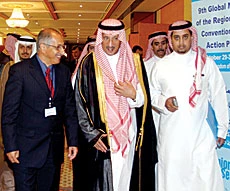
JEDDAH, 30 October 2007 — The Ninth Global Meeting of the Regional Seas Conventions and Action Plans opened its deliberations in Jeddah yesterday with the topic of climate change prominent on the agenda.
The meeting in Jeddah was held under the auspices of the United Nations Environmental Program (UNEP) and in concert with the regional Organization for the Conservation of the Environment of the Red Sea and the Gulf of Aden (PERSGA). The purpose is to review and monitor progress in the implementation of marine and coastal developments in the 104 states that attended the meeting, and set plans for developments for the next four years.
Prince Turki ibn Nasser ibn Abdul Aziz, president of the Meteorological and Environmental Protection Administration, welcomed the delegates to the Kingdom and said that the meeting would support environmental research on both the local and international levels. During his address, Prince Turki said that an action plan had been put in place to clean up 200 kilometers of Jeddah’s coastline and beaches.
“Custodian of the Two Holy Mosques King Abdullah has directed us to start studying the possibility of cleaning 200 kilometers of Jeddah’s beaches,” he said. Prince Turki expects the project to begin in 2008. The clean-up drive would be mirrored in the next two months by the cleaning of 800 kilometers of Gulf beaches that suffered from pollution caused by the second Gulf War.
“PERSGA’s energetic participation in this meeting will tremendously benefit everyone and will give us a boost to revive the Red Sea environment and protect it from further pollution,” said the prince.
Ibrahim Thiaw, director of the Division of Environmental Policy Implementation, said that the meeting was particularly important to establish strategies in view of the significance of climate change. He said that the highest subject on the meeting’s agendum was the impact of climate change on the environment, particularly the marine and coastal ecosystems.
Thiaw added that the UN International Panel on Climate Change had produced its fourth report — to be launched in mid-November this year — and that the report was very clear on the subject. “Climate change is with us; it is now an unequivocal fact,” he told Arab News. “We have to work together to address this.”
He added that 60 percent of the world’s population lived on the coast or in coastal areas and therefore the potential negative effects of rising sea levels were of particularly importance. He also agreed that there were massive demographic and political problems associated with climate change.
Thiaw sees the issue of how to use the marine ecosystems that were almost unknown to the general public as another challenge. Reefs, marine habitats and protected areas, he said, were all causes for concern. “A marine ecosystem assessment by the UN between 2000 and 2005 has showed that these have declined, and that there is a general collapse of world fisheries. There will implications of this on the human population, especially on the poorest of the poor, when these systems, especially ecosystems, decline in providing livelihoods for them,” he said.

