JEDDAH, 1 November 2007 — Traffic jams and extremely crowded streets are annoying not only to drivers but also to pedestrians who have to pass through Jeddah’s streets. Local residents are particularly concerned over what the city may look like in the next five years.
In order to rein in speeding drivers and to help make Jeddah’s roads safe, the Traffic Department has implemented a fines system that penalizes drivers with a view to minimizing the occurrence of horrific accidents.
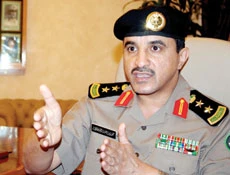
Arab News recently met Col. Muhammad Al-Qahtani, head of the Jeddah Traffic Department, to learn how the department organizes traffic in the city and how violators are punished.
“It is not only plainclothes policemen that help us arrest speeding drivers. We also have police cars on the lookout for erring drivers. People driving irresponsibly have caused us to recruit plainclothes policemen, who are provided with different types of equipment, including radars,” said Al-Qahtani, adding that plainclothes policemen were able to document more than 200 violations in a single day on King Fahd Road.
The traffic police chief added that the number of deaths on Jeddah roads has decreased following the implementation of the new strategy of detaining drivers who speed. “In the third quarter of the year 2006, 156 people died in car accidents. This year in a three-month period, 108 people have died in car accidents,” said Al-Qahtani.
The traffic department chief said the new system has helped reduce the number of violations and consequently the number of car accidents. “If there is a better system that would prevent accidents from happening then we would have implemented it. Previously we were penalizing violators through hefty fines. We all know that the majority of violators are youngsters between the ages of 18 and 25. It is not sufficient to levy fines. They don’t learn. In most cases their guardians pay the fine, even if we ask for SR2,000,” said Al-Qahtani.
“Detaining them is a better deterrent,” said Al-Qahtani. “The maximum speed on Al-Madinah Road is 100 kmph. We give warnings to drivers who reach 130, and issue tickets when they go over 140. However, when they exceed 150 we detain them for several hours ranging from 24 to 72 hours,” said Al-Qahtani, adding that the Decision Committee at the Traffic Department determines the number of hours depending on the speed of violation.
Speaking about whether drivers can complain about the penalties they are given, Al-Qahtani said: “Both citizens and expatriates have the right to complain about violations including detainment. The Decision Committee has three officers and anyone who wants to lodge a complaint or who feels a judgment has been unfair can write to the committee.”
Al-Qahtani added that complainants would be assigned a specific time to present their case. “The Decision Committee meets twice a week on Monday and on Thursday and has so far resolved many complaints.”
Traffic Police use radars to document violations and faulty radars are often returned to suppliers to ensure a fair reading. “Plainclothes policemen in unmarked cars are deployed across Jeddah around the clock. They radio information about speeding cars to police located close by,” said Al-Qahtani.
“Most drivers deny that they are speeding when stopped because they generally don’t know about the secret police,” said Al-Qahtani, adding that plainclothes police comprise just 10 percent of the Traffic Department’s work force.
“On a daily basis, hospitals receive 200 cases related to accidents, which are usually caused by speeding drivers and drivers running red lights. We cannot have our police cars everywhere. Therefore, we have plainclothes policemen, who help document violations,” he said.
Al-Qahtani denied that traffic police officers tend to document random violations to meet monthly quotas. He said that there are different officers, who follow up on violations to ensure they are correct, and added that the Decision Committee plays a huge role in investigating such cases.
Speaking about the problem of maintaining traffic in Jeddah, Al-Qahtani said there are several solutions to the problem, which include elements of organization, operation and engineering. “When the number of vehicles on roads exceeds their capacity, then there would be a need to establish bridges and to provide different means of transportation that include underground passes, buses, and trains,” said Al-Qahtani.
He added that the Traffic Department has conducted its own study about the causes of congestion in Jeddah. “Among these causes is the increasing number of malls that do not have proper car parking spaces. Over the last 25 years, the number of vehicles in Jeddah has rapidly increased,” said Al-Qahtani. “Madinah Road is an important road that links north and south Jeddah, while Prince Muhammad Road is a main road that links the western areas of Jeddah to the eastern areas. Along the sides of the two roads there are minor streets that vehicles can use to drive on to and off the main road,” said Al-Qahtani. “To ease traffic congestion, we tend to close these side roads at peak hours as a permanent solution to traffic jams,” he added.