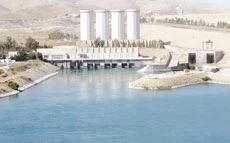
BAGHDAD, 1 November 2007 — Iraq yesterday said it was working round the clock to shore up a dam, which was this week, branded as “the most dangerous in the world” and denied the structure faced an imminent danger of collapse. US experts warned Baghdad on Tuesday that the dam on the Tigris River near the northern city of Mosul could buckle under water pressure and let loose a 20-meter (70-foot) wave on to the regions below, including Baghdad.
One report talking about potential erosion of the Mosul dam’s foundations termed it “the most dangerous dam in the world.” But Baghdad dismissed these remarks. “These reports are not accurate and are totally untrue,” Iraqi government spokesman Ali Al-Dabbagh said.
He said the dam is under constant observation and “all precautionary measures in terms of maintenance are regularly carried out.” “There are teams working round-the-clock to strengthen the dam.” The US assessment was part of a report by the US Army Corps of Engineers (ACE), which said the current probability of dam failure was “exceptionally high.”
Its comments were included in a review of dam fortification work by the US Special Inspector General for Iraqi Construction (SIGIR) dated October 29 and released on the Internet on Tuesday. The SIGIR report also includes a letter sent in May to Iraqi Prime Minister Nuri Al-Maliki from the US Ambassador to Iraq Ryan Crocker and US military commander Gen. David Petraeus in which they warned of the risk of a massive disaster if the dam breaks.
“In terms of internal erosion potential of the foundation, Mosul Dam is the most dangerous dam in the world... If a small problem (at) Mosul Dam occurs, failure is likely,” the ACE concluded. “A catastrophic failure of the Mosul Dam would result in flooding along the Tigris River all the way to Baghdad,” the report said, noting that just 50 kilometers downstream is the city of Mosul, with 1.7 million people.
Meanwhile, Iran’s Foreign Minister Manouchehr Mottaki said yesterday Iran is willing to hold further talks with the United States on improving security in Iraq. Mottaki also said Iran would present a plan on Iraq at a meeting of Iraq’s neighbors in Istanbul this weekend but gave no details of what it would propose.
Washington has said it is willing to attend a new round of talks with its longtime foe, whom it accuses of fueling Iraq’s sectarian violence by arming and funding Shiite militias. Iran denies the charge. “About the readiness of the Americans for a new round of talks ... I respond that we do consider positively this initiative,” Mottaki told a joint news briefing in Baghdad with his Iraqi counterpart Hoshyar Zebari.
It was not clear whether he was referring to ambassadorial level talks or the subcommittee set up by Iran, Iraq and the United States to improve cooperation on Iraqi security. The committee has met only once, in August. “I had a positive response from (Mottaki) that the Islamic Republic is ready to continue the dialogue because this is a very useful and important channel for dialogue and helping the situation in Iraq,” Zebari told reporters.
Mottaki was in Baghdad for talks with Iraqi leaders ahead of the two-day Istanbul conference. “Our delegation participating in the conference will deliver a (plan) regarding the situation in Iraq,” he said. Crocker said last week that Iran’s involvement in Iraq “continues to be a mixed, cloudy picture.”