
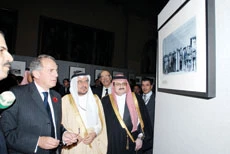
CURRENTLY at the Victoria and Albert Museum in London as part of a three-day festival about Saudi Arabia, a unique exhibition of photographs draws pictures of the past century. The collection of photographs are on exhibit in the UK for the first time; they come from the King Abdul Aziz Public Library archives (in Riyadh) and they show the first visit by a British to Saudi Arabia.
Princess Alice — the daughter of Queen Victoria’s youngest son, Prince Leopold — visited the Kingdom of Saudi Arabia in 1938. During the visit, she took a number of photographs documenting her visit. Said to be the second European woman to be granted an audience with King Abdul Aziz, Princess Alice was warmly received by the king and the royal family. (The first was probably Gertrude Bell.) She traveled from west to east across the Kingdom for three weeks, camping out in the desert and wrapping herself in a long black abaya when in the company of Arab men.
The Times (of London) states that the princess’ visit came about by chance after she met Prince Faisal (later King Faisal) at the Ascot racecourse. The exhibition, entitled “A Century Remembered,” is a vivid picture of life in those times. The princess and her husband, the Earl of Athlone, visited Riyadh, Jeddah and Hail. They went on hunting trips and tea parties with members of the Saudi royal family. Princess Alice was also the second European woman to cross the Arabian Peninsula, the first being Dora Philby wife of St. John (Abdullah) Philby, a friend and adviser of King Abdul Aziz.
The pictures document the trip of the princess and her husband between cities and it notes the important stops on the way. They reflect an obvious fascination with hunting trips, and the desert as a whole. One of the beautiful pictures shows a car in the middle of the desert with falcons on the sand around it; one of the birds has actually chosen to sit on the back of the car.
The picture is simple and yet it makes many contrasts and reflects the vision behind it that saw the two worlds meeting in one simple photograph.
The royal party visited Wadi Fatima where they had a picnic. The pictures show the princess and the earl with Abdullah Philby, enjoying his company and drinking Arabic coffee. The picture that shows the group at Diriyah Palace drinking tea with members of the Saudi royal family illustrates the theme of two cultures meeting over a common ceremony — after all, drinking tea is an essential part of both Arab and British cultures.
Throughout the exhibition the princess seems to have fallen in love with the old forts and buildings. She took many beautiful shots of Murraba Palace in Riyadh; another shows a deserted fort outside Hofuf. One rare picture shows the princess in front of the Al-Themeri Gate in Riyadh, and this is said to be the first colored picture of the Saudi capital.
The princess also documents the old buildings of Jeddah, its narrow alleys and wooden windows (roshan). She poses in front of the Makkah Gate in Jeddah with daily life going around her and people moving about in their normal daily way.
Princess Alice’s fascination with the Arabian desert and the country is obvious also from the pictures she took while wearing traditional women’s clothing. She put the black abaya with golden threads ornamenting the hems over her head, showing only her face, while another woman actually covers her face with the abaya. The earl walks around the guest palace, where the party is staying, wearing the meshlah, and in another picture he wears the agal (head ropes) as well.
The presence of Abdullah Philby in the pictures also highlights European interest and fascination with Arab life. Princess Alice wrote of him in one of her letters: “He is most interesting and knows everything one wants to hear about, even about rare birds and gazelles and plants. No one in the English Colony likes him, as he is now a Musselman [sic] and a free lance diner with the king, but he’s the only man worth talking to.”
Princess Alice loved photography and from looking at what she produced, one can only be glad that she did. She produced priceless and wonderful pictures that say a great deal about life in the Kingdom just before the middle of the 20th century.