ISLAMABAD, 5 November 2007 — The United States and Britain yesterday said they will review their financial aid to Pakistan as over 600 political activists were arrested in a nationwide crackdown after President Gen. Pervez Musharraf declared a state of emergency on Saturday.
Washington has provided Islamabad, a major ally in its battle against Al-Qaeda in Pakistan and neighboring Afghanistan, with around $10 billion over the last five years. It has condemned the imposition of emergency rule.
“Obviously we are going to have to review the situation with aid, in part because we have to see what may be triggered by certain statutes,” Secretary of State Condoleezza Rice was quoted as telling reporters traveling with her in Jerusalem. But she added that the United States still wanted to cooperate with Pakistan on counterterrorism issues.
A British Foreign Office spokesman said Britain would consider the implications of the new situation on its programs in Pakistan, but he declined to say when such a review would take place or if it would lead to a change in the amount of aid given.
Pakistan, the second-largest recipient of British bilateral development aid, is scheduled to receive some 480 million pounds ($1 billion) in assistance between 2008 and 2011, Britain’s Department for International Development said.
In the Pakistani capital Islamabad, Prime Minister Shaukat Aziz said national elections, due in January, might be rescheduled.
Aziz told a news conference that “the Parliament could give itself more time, up to a year, in terms of holding the next elections.”
The premier said up to 500 people were being held in preventive detention. He declined to say how long the state of emergency would last.
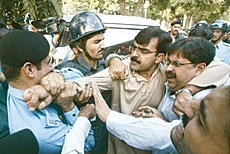
Hours after the press conference over 100 people, mostly young activists shouting “Go Musharraf Go,” were baton-charged, put into trucks, taken to Rawalpindi’s Adiala prison and locked up.
Activists arrested during the day include Javed Hashmi, acting chief of former premier Nawaz Sharif’s party, leading rights activist Asma Jahangir, cricketer-turned-politician Imran Khan and Hamid Gul, a former chief of Inter-Services Intelligence (ISI). “I am neither afraid of prison nor of generals, because I have served the major part of my political life in prison,” Hashmi told reporters alerted to the raid on his house in the central city of Multan.
Musharraf’s first decisive step after announcing the state of emergency was to replace outspoken Chief Justice Iftikhar Muhammad Chaudhry, a thorn in his side since the general first tried to sack him in March.
The new chief justice, Hameed Dogar, canceled Chaudhry’s caseload.
As well as considering legal challenges to Musharraf’s election, Chaudhry had been hearing hundreds of human rights appeals from families of people who went missing over the last four years because of alleged Al-Qaeda links.
Police yesterday surrounded a compound where Chaudhry and other judges live.
— Additional input from agencies