
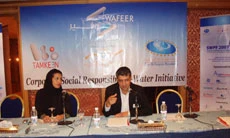
JEDDAH, 8 November 2007 — With growing awareness of corporate social responsibility (CSR), the business sector should give top priority to tackle the water issue, an expert said on Monday night during the Saudi Water and Power Forum.
Saudi Arabia is among the 10 most deficient countries in terms of fresh water resources. “We are not the most efficient users of water. We are experiencing an accelerated growth in population and economic activities, all adding to increased stress on a limited resource. Meeting growing demand is a monumental activity,” Dr. Asya Al AlShaikh, chairman and CEO of Jeddah-based Tamkeen Management and Development Consulting, said.
“My only worry is that in the current framework, we risk focusing too much on supply and little on demand. And with this focus, we risk compromising on some of the dimensions of responsibility including the perpetual cycle of wasteful consumption and continued polluting on the production side,” she said, adding that there exists an opportunity for the corporate sector to fulfill social responsibility.
In developed economies, companies and organizations working in the utilities sector also pay attention to the sustainable and efficient use of resources, especially water. “I see positive signs from some of our local companies,” she said and announced the formation of the first public-private cooperation on efficient water management in the industrial and commercial sector with the support of the Ministry of Water and Electricity. “This Wafeer water initiative is one example where private sector can demonstrate a commitment to social responsibility by helping to promote sustainable and efficient use of water,” Asya said. The initiative will engage in capacity building activities for efficient water management and utilization at the facility level, collect data and measure performance to encourage benchmarking and raising awareness.
The private sector has an important role to play in such initiatives, both as supporters and knowledge providers and participants in various activities, she said.
Asked whether international companies active in this part of the world are supporting the initiative, Tareq Emtairah, CSR consultant at Tamkeen and professor at Lund University, Sweden, said: “Unfortunately, international companies have not come forward to support the Wafeer initiative,” he said, adding that aside from promoting awareness and capacity building, the water initiative is aimed to meet needs of the precious resource by 2025 and beyond with the support of the Ministry of Water and Electricity, and public and private sectors. Dar Al-Taqniya Academy is its strategic partner and Moya among its other supporters.
The increasing number of desalination plants has conventionally been the dominant approach in tackling the water problem.
This approach, however, falls short of offering a sustainable solution. On one hand, desalination and the transport of desalinized water increases the emission of pollutants which in turn can have a more adverse impact on water availability, and on the other, desalination is unable to close the rapidly widening gap between increasing demand and declining supply.