
RIYADH, 9 November 2007 — The first batch of Saudis will be leaving for the United States within the next few months as part of the US-Middle East Partnership for Breast Cancer Awareness and Research, signed between the US and Saudi Arabia last month.
Dr. Abdullah Al-Amro, CEO of the King Fahd Medical City (KFMC), said that as part of the agreement several Saudis in the health sector are to receive training opportunities at the M.D. Anderson Cancer Center at the University of Texas.
“The basic plan is to begin within a couple of months with exchanges of visits. In addition, Saudi men and women will be given training opportunities,” Al-Amro said.
The US-Middle East Partnership for Breast Cancer Awareness and Research is the first joint cooperation program between the US and Saudi Arabia in the fight against cancer. US First Lady Laura Bush witnessed the signing of the agreement during her visit to the Kingdom last month.
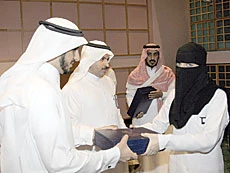
Speaking to Arab News following a graduation ceremony of health care personnel in nursing held at KFMC on Sunday, Al-Amro said that the Tumor Center in the city would be operational in two months’ time.
“The center will have a 300-bed capacity in the next two years. It is expected to be among the most specialized centers in tumor diseases in the Kingdom,” he said, adding that the city’s outpatient units are expected to expand and that in the near future, it will have the capacity to absorb 120,000 visitors per year.
Al-Amro said that the administration is currently considering the establishment of a specialized nursing college that would be opened in the city. “We are studying the possibilities,” he said, adding that the proposed college would teach intensive care nursing, emergency room nursing, tumor nursing, and heart care nursing.
The official mentioned that the process of replacing foreign health employees with competent and professional Saudi medical staff was one of the objectives of the city, as long as this is done in a proper manner.
“We aim to replace non-Saudis with Saudis without jeopardizing workflow on condition that Saudis project a positive image of themselves and the country,” he said, referring to the Saudization process.
He admitted that there was a shortage of Saudi nurses. “It is known that nursing colleges in Saudi Arabia, which graduate students with bachelor degrees, are very few. Most of the local graduates have diplomas,” he said.
Referring to the specialized Heart Center located in the city, which is considered to be the most sophisticated in the Middle East, Al-Amro said that the city had successfully undertaken 450 open-heart surgeries since its launch, and 1,200 bypass surgeries.
KFMC is considered to be the largest medical complex in the Middle East. The total capacity of the entire city is 1,095 beds. It has three operational hospitals: A children’s hospital, a rehabilitation hospital and a women’s specialist hospital. It also has four specialized centers: A diabetic center, a neurosciences center, a hematology and oncology center, and a heart center.
The city was inaugurated on Oct. 24, 2004, by Custodian of the Two Holy Mosques King Abdullah.

