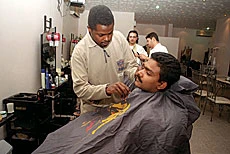
JEDDAH, 9 November 2007 — In order to run a successful hair salon, barbers, like people of certain other professions, need to build relationships with their customers. Otherwise they risk losing them forever. For a barber, a satisfied customer is a customer who is definitely going to return, something that is good for business.
With reports of an unsatisfied customer shooting his barber after a bad cut in the United States, barbers have a fine line to tread when dealing with customers.
“I never let anybody cut my hair, except my Moroccan barber. I always go to him, even if this means going without a haircut for months,” said Ahmady Al-Baeti, an engineer living in Jeddah. “I’ve been going to him for 15 years now and I never let anyone else cut my hair,” he added.
As a civil engineer, Al-Baeti often leaves Jeddah on work-related matters. “Sometimes I don’t get my hair cut for over two months. I wait until I return to my barber in Jeddah. I’ve stayed for months without cutting my hair,” he said.
Ahmad Al-Fayoumi, a branch manager at a company located in the south of Saudi Arabia, said he used to have his hair cut by an Egyptian barber in Jeddah’s Al-Salama district. “I used to visit him whenever I came to Jeddah,” he said. “One day I was coming to Jeddah and decided to go to my favorite Egyptian barber. His name was Muhammad Al-Masri. I called him on his mobile to tell him that I was on my way when someone else answered the phone and told me that he had died,” said Al-Fayoumi.
Content with his Turkish barber, Zarea Al-Maliki travels across Jeddah just to get a haircut. “I got used to my Turkish barber called Omar Oglow. He used to work at a barbershop near my house. He’s currently working at another shop in a different area. I go there all the time, even though it wastes a lot of time and takes a lot of effort,” he said.
Hamid Attas, an Aramco employee in Jeddah, visits a barber located in the foyer of a five-star hotel. “He’s the only one I feel satisfied with. I’ve tried several barbers in regular barbershops but I’ve never felt satisfied,” he said, adding that his barber charges three times more than a regular barber. “I’m ready to pay it because it is a five-star service. Most of his customers are celebrities and VIP figures, who like to have their hair cut in a special way,” said Attas.
Businessman Dr. Ali Al-Nakor asks his Egyptian barber to come to his home to cut his hair. “I provide him with everything, including scissors, machines, shampoo, combs, brushes and other tools. Infectious diseases could get transferred when visiting barber shops and so I get my hair cut at home using my own tools,” said Al-Nakor.
Barbers in Saudi Arabia tend to be of different nationalities. They include Turks, Egyptians, Moroccans and Indians. However, many customers prefer dealing with people of their own nationalities.
While Saudis are not choosy in who they visit, Asian customers tend to only visit barbers of their own nationalities. Hassan Nasser, a Saudi citizen working in the media, said: “I don’t have a particular choice of barber. Sometimes I keep my hair uncut for a long time and then when I go to the barber, I let him cut my hair the way he thinks suitable.”
Barbers charge from between SR15 and SR100, according to the service they provide and where the salon is located.
Muhiuddin Abul Kalam, a Bangladeshi driver, said that he visits a Bengali hairdresser on Makkah Road who charges only SR5. “This price is only for customers of Asian origin. Saudis and others pay SR15 or SR20,” he said. “When I first came to Jeddah, the high prices forced me to cut my hair by myself. However, I couldn’t do it properly and so decided to go to the cheapest hairdresser that I knew at the time. Bangladeshis prefer going to their compatriots rather than anyone else,” he said.
Muhammad Ataya, an Egyptian barber, said there are two types of customers that he deals with. “The regular one is very easy to deal with because I know him very well and know what he exactly wants. The customers who come only once or twice are more difficult to deal with,” he added.