
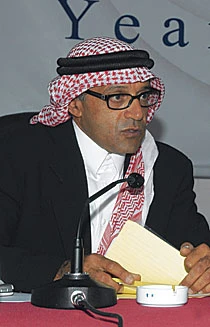
JEDDAH, 9 November 2007 — The Saudi Water & Power Forum (SWPF) ended on Wednesday night with a call for innovation and integration in water and power sectors.
The event, which began on Saturday, was termed a “big success” by SWPF Chairman Dr. Adil Bushnak. The forum, developed to offer an interactive and highly informative experience, achieved its aims and objectives, he said in his concluding remarks.
“We live in a world of environmental chaos due to the high levels of carbon dioxide emissions produced by or global industries, which causes severe damage to our global environment. We must therefore collectively agree on creative means to control and reverse this damage,” said Tarek Abdulhadi Taher, president and CEO, Al-Taher Group.
Heading a panel, he discussed issues on local private industry becoming an active player in carbon credit and environmental sustainability.
“As a farmer and an industrialist, I am delighted to learn that carbon credit can be stored in soil which encourages me to further develop our farming capacity so that we can use carbon offset methods to reduce our industrial carbon dioxide emission impact, and possibly sell it, which will make us an active player in reducing carbon dioxide emissions locally and globally,” Taher said.
Referring to a criticism in the World Bank report titled “State and Trends of the Carbon Market 2006,” he said that many environmental activists and foundations considered a strong advocation of carbon trading to be a denial of the imminence of climate change and a formalized failure of international policy to address the gravity of the carbon increase.
“Critics of carbon trading, such as Carbon Trade Watch argue that it places disproportionate emphasis on individual lifestyles and carbon footprints, distracting attention from the wider, systemic changes and collective political action that needs to be taken to tackle climate change,” he added.
He suggested replantation of mangroves and coral reefs, and preservation of local forests and enhancing them, such as the Juniper Forest on Asir mountains, as ways to benefit from the carbon credit offset methodology.
“I totally understand that it is a tough act to balance between industrial growth and environmental sustainability. But that should not stop us from asking the question ‘what is more important to our children and grand children: short-term financial gain or global environmental sustainability,’ and the answer is obvious,” he added.
Walid Fayad, principal, Booz Allen Hamilton, gave a presentation on optimizing national strategy for water and power production and distribution. He called for adopting an integral resource planning approach for the water and power sectors.
These sectors are inherently linked by the prevalence of cogeneration and desalination in the Kingdom. While integration affects most of the water and power service delivery chain, its benefits are mostly observed in resource planning, he said.
“The Kingdom’s resource planning approach must address a number of challenges to achieve its critical objectives,” he said and identified water scarcity, strong population and high economic growth, prevalence of cogeneration, sector transformation and high subsidization as among the challenges.
Fayad noted that the water and electricity sector in the Kingdom is currently undergoing significant transformation, introducing a number of new players. In this context, he said, adopting an integrated resource planning will allow to capture additional value beyond traditional planning methods. A single entity for handling integrated resource planning for water and power appears as the most suitable approach for the Kingdom, he added.