
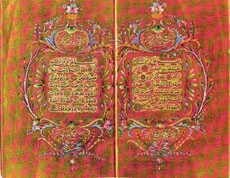
BAIT Al-Qur’an in Manama, Bahrain, is one of the most renowned Islamic museums in the world. The museum presents a unique collection of Qur’ans from different historical periods and different styles of writing. The museum also includes a mosque, a Qur’anic school and exhibition halls.
Construction began on the museum in 1984 and it was opened in 1990. Its collection of Islamic manuscripts and other antiques comes from presentations or, in some cases, loans. Muslim heritage is presented through pictures, videos, cassettes and drawings.
The museum is designed according to traditional Islamic architecture but with modern touches. It is divided into five sections and has an open court with a fountain. A special traditionally-designed minaret that goes back to the 12th century is in the open court.
The museum is a gift from Abdul Rahman Jasim Kanoo. Among the sections of the museum is the Kanoo Mosque, which can hold up to 150 worshippers. It has a glass dome with an unusual interplay of colors. The dome is considered one of the largest of its kind in the world. Ahmad Mustafa, a famous Egyptian calligrapher, has written Qur’anic verses on the dome and also in other parts of the mosque and the museum. The glass and material needed for building the dome was brought from Britain. The place in the mosque where the imam or prayer leader prays (mehrab) was made by a highly skilled Turkish designer; it has the year of construction on it as well as different Qur’anic verses.
The Yousef ibn Ahmad Kanoo’s school is another part of the museum. It has seven rooms equipped with the latest modern technology and the school’s aim is to teach both the Qur’an and Qur’anic studies.
Bait Al-Qur’an is where one can find Qur’anic manuscripts of different shapes and of different handwriting that come from around the world — from China to Andalus (Spain).
Bait Al-Qur’an introduces visitors to the gradual development of Qur’an manuscripts in different styles and materials that vary from one period to another. The Museum aims at introducing the Qur’an to others, explaining its noble meanings to the public and encouraging people to learn and study Qur’an. It also sponsors different Islamic researches and hopes to collect an even greater number of Qur’anic manuscripts.
For more information: http://www.beitalquran.com/