
RIYADH, 19 November 2007 — Saudi Minister of Petroleum and Mineral Resources Ali Al-Naimi said here yesterday that the Kingdom was scouting for investment opportunities in oil refineries in Asia within the framework of the Riyadh Declaration to maintain oil supplies.
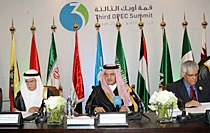
In a press conference attended by Minister of Foreign Affairs Prince Saud Al-Faisal, Minister of Finance Dr. Ibrahim Al-Assaf and OPEC Secretary General Abdullah Al-Badri, Al-Naimi said augmenting refining capacity would be done at two levels.
The Kingdom was planning to double its own oil refining capacity from the current level of 3.2 mbpd to six million barrels per day (bpd) within the next five years, “but we would also be interested in investing abroad. Already, we have set up or are establishing joint ventures in refineries in various Asian countries like China, Japan, South Korea and the Philippines.”
Though he did not mention India by name when he spoke about their interest in expanding these areas of cooperation, both countries are considering a proposal to set up an oil refinery in India as part of a joint initiative to boost their bilateral relations in the energy sector. The scope of such cooperation was explored during the meeting that Al-Naimi had with the then petroleum minister Mani Shankar Aiyar for boosting trade and investment opportunities in the oil, gas and mineral sectors.
The new joint venture will import crude oil from the Kingdom and supply refined products to India’s burgeoning market in the oil and gas sector.
Companies such as HPCL are seeking partnership with Saudi Aramco and setting up refineries in Saudi Arabia and India. The two companies are also exploring joint marketing activities in India. Speaking on the implications of the Riyadh Declaration, Prince Saud hoped that it would lead to stability in the oil market by promoting greater coordination among the OPEC and the non-OPEC countries in terms of maintaining supplies and promoting joint investments in the oil distribution and refining sector.
He said the Riyadh Declaration was inspired by the three primary objectives of the summit — promoting prosperity, oil supplies, and preserving the environment.
Al-Naimi further said that “fluctuations in the market have nothing to do with OPEC,” adding that there were many other factors affecting oil prices, such as the geopolitical situation in the region, logistic issues, procedural delays at the ports of call, and constraints on refining the crude supplies. Both Al-Naimi and Prince Saud said oil prices were now market-driven, as OPEC had stopped fixing oil prices since 1986.
In reply to a question on environmental protection, the foreign minister said Custodian of the Two Holy Mosques King Abdullah had already unveiled his initiative in this direction by pledging $300 million toward the setting up of a research center to tackle issues concerning global warming.
Asked about the impact of economic reforms, Dr. Al-Assaf said the taxation regime had been streamlined and bottlenecks facing investors ironed out.
This had resulted in the flow of foreign direct investment, which SAGIA Governor Amr Abdullah Al-Dabbagh estimates, would reach more than $94 billion by 2009 in the Kingdom’s downstream hydrocarbon sectors alone. The goal is to draw in $1 trillion in FDI over the next 20 years.
On the possibility of Brazil joining OPEC, Al-Badri said no such application had been received.
However, there were certain procedural formalities that the country would have to comply with. “And when it does, it will be evaluated by the relevant committee,” he added.
In reply to a question on the fire that broke out at Saudi Aramco’s Haradh-’Uthmaniyah pipeline, Al-Naimi said it will have no impact on the company’s oil production capacity since it was a new pipeline.