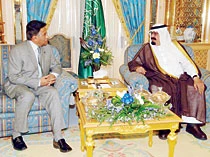
RIYADH/ISLAMABAD, 21 November 2007 — Custodian of the Two Holy Mosques King Abdullah held talks with Pakistani President Pervez Musharraf at Al-Yamamah Palace here yesterday. Musharraf arrived in Riyadh earlier in the day on his first official trip abroad since declaring a state of emergency on Nov. 3.
The president’s visit comes as Pakistan announced the release of thousands of prisoners detained under emergency rule and set Jan. 8 as the date for general elections aimed at ending weeks of political turmoil. The authorities also said yesterday that the sacked Supreme Court judges held under house arrest were free to move.
On arrival at the Riyadh air base, Musharraf was greeted by Foreign Minister Prince Saud Al-Faisal, Prince Muqrin, chief of intelligence, and other senior government officials. Ali Awad Al-Aseeri, Saudi ambassador in Islamabad, and Shahid Karimullah, Pakistan’s ambassador in Riyadh, were also present.
“It was a personal visit and the two heads of state had a one to one meeting for more than two hours,” Ambassador Karimullah told Arab News, adding that the meeting was preceded by a half-hour meeting in the presence of Prince Saud and Prince Muqrin. According to sources, besides the current issues in Pakistan, the two leaders discussed matters of bilateral interests, and regional and international issues concerning the two countries.
Musharraf was accompanied by Lt. Gen. Nadeem Taj, head of the Inter-Services Intelligence. Following the meeting with the king, Musharraf left for Makkah where he is expected to perform Umrah.
Prior to the meeting with the king, the president paid a courtesy call on Crown Prince Sultan, deputy premier and minister of defense and aviation. The crown prince begins a three-day visit to Russia today in response to an invitation from President Vladimir Putin.
Pakistan Consulate’s Jameel Khan told Arab News that Musharraf will be going to Makkah with the purpose of performing Umrah. He ruled out speculations that the president would meet Nawaz Sharif.
In Islamabad, Attorney General Malik Qayyum said that Musharraf will likely commence a further five-year term later this week after stepping down as army chief. “He will be sworn in as a civilian president, there is no doubt about it,” Qayyum said, adding that the ceremony could take place on Friday or Saturday, depending on the imminent ruling of the Supreme Court on Musharraf’s Oct. 6 re-election.
The reconstituted court this week threw out several petitions challenging his eligibility to run for office while still serving in the army. A final petition is due to be heard tomorrow and is also expected to be dismissed.
Officials announced yesterday that Pakistanis will vote in general elections on Jan. 8, setting a schedule for polls which the opposition has threatened to boycott amid the crisis over emergency rule.
It kick-starts campaigning in a process designed to return Pakistan to democratic rule. Chief Election Commissioner Qazi Muhammad Farooq said his officials would ensure fair and impartial polls. It was not immediately clear how many opposition parties will take part in the vote.
“The attention of the entire world is focused on our elections,” he said on state television. “I would therefore appeal to the participants and the voters to cooperate with the election commission in holding elections peacefully.”
Farooq said authorities had imported transparent ballot boxes to ensure a fair vote and that his staff had been trained to high standards. “International observers will be welcomed and provided all facilities. They will be allowed to visit all polling stations,” he added. Nomination papers can be filed from today until Monday, and a final list of candidates will be displayed on Dec. 15, officials said.
The authorities freed 3,400 people detained under a state of emergency and will soon release the remaining 2,000. “The federal and provincial governments have released 3,400 people including political workers and lawyers. Some 2,000 remain in detention. They will also be released soon,” Interior Ministry spokesman Javed Cheema said.
That would leave “very few” detainees facing criminal charges and who must apply for bail through the courts to be released, Cheema said.
Former cricket star Imran Khan remains in jail where he faces charges under anti-terrorism legislation. His party said on Monday that he had gone on hunger strike.
Despite the authorities saying that the former Supreme Court judges were free to move about, one of the judges said he and his colleagues remained under tight security and cumbersome official restrictions that meant they were effectively still in detention. “The judges are free to go from their homes, they are free to move,” Cheema told reporters. “Those who are staying back at their homes are staying of their own accord.”
Ousted senior judge Rana Bhagwandas said there were still heavy restrictions on them. “(Chief Justice) Iftikhar Muhammad Chaudhry still can’t come out of his house, the police are still laying siege to it. The other day I tried to meet him but I could not,” Bhagwandas said.
— Additional input from agencies