
LONDON, 21 November 2007 — Millions of Russians will go to the polls next month in crucial parliamentary elections for the Duma, the outcome of which may well decide the political future of two-term Russian President Vladimir Putin, who has to make way for a successor in the March 2008 presidential election.
For Russia’s 20 million-plus Muslims, however, this will also be a watershed election. According to businessman Dr. Adalet Djabiev, who is standing as a candidate for the Union of Right Forces (URF) Party, it is time for Russian Muslims to decide whether they “want to transform themselves from being a risk group for the law enforcement and intelligence services to a responsible political stakeholder in modern Russia.”
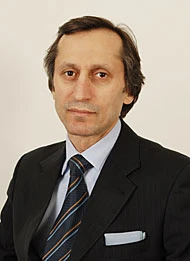
Azerbaijan-born Dr. Djabiev, the former CEO of Badr-Forte Bank in Moscow, a pioneer of Islamic banking in Russia, is standing in the Penza District constituency, which has a significant Muslim population and is situated 700 km to the south of Moscow, close to the Tataristan capital Kazan and juxtaposed between the Pavolsja Region and Tataristan.
“I am included in the list of the URF,” explained Dr. Djabiev in an interview with Arab News during a recent visit to London. “The URF is a moderate liberal center-right party, which was founded by former Prime Minister Ygor Gaidar during the presidency of Boris Yeltsin, and which is now led by Nikita Belykh, a 33-year-old ‘Young Turk’ who is a former vice governor of the Perm District in the Urals Area of Russia. He resigned from his post to enter politics and to fight corruption and cronyism and to fight for democratic values and accountability,” he added.
Dr. Djabiev is standing on the URF ticket because the party has been foremost in fighting xenophobia and ultra-nationalism, and has supported the rights of minorities in the country. The URF, says Dr. Djabiev, strongly supports freedom of speech and of religious affiliation. The party is also a strong proponent of the market economy, but believes in compassionate capitalism where the state helps those less fortunate in society.
Indeed, the URF, with its new party slogan “Liberty and Humanity,” has undergone a political transformation from the naked monetarism of its Yeltsin years in the early 1990s. It claims it has evolved into a more pragmatic and compassionate one-nation party, which encompasses strong market economic management with welfare safety nets such as affordable pensions and social security.
“This is the only party in Russia, which has adopted such an agenda. The Communist Party, on the other hand, plans to do this by grabbing from the rich and distributing it to the poor — a legacy from the old Soviet polity. Some of the other parties are even more cynical — if a person is poor it is entirely his fault for not being able to lift him from the poverty trap,” explains Dr. Djabiev.
Critics say the majority party in the Duma, the United Russia Party (URP), which was created by the Kremlin at the end of 1990s to rubber stamp its policies, has turned the economy into one huge state corporation, with all its inefficiencies and various entities. Each entity serves the interests of a clan within the Russian establishment.
Critics allege that the Parliamentary Committees of the URP is filled with apparatchiks, who are mainly former officers of the intelligence services such as the KGB, and law enforcement services such as the Interior Ministry. These institutions have been empowered with an array of new laws over the last eight years, which have given them virtually unlimited control. This culture of power is pervasive across Russia. However, according to Dr. Djabiev, its biggest impact has been on the country’s 20 million or so Muslims, who have suffered and are still on the receiving end of draconian police stop-and-search powers in the so-called fight against Islamist terrorism and extremism.
The URP in fact is accused of increasing bureaucracy in Russia to levels higher than the communist area. All bureaucrats in the Russian government at all levels — from federal, to state to municipality-are members of the party.
Traditionally, Muslims either refused to participate in the elections or supported the so-called “protest vote” party, the Communist Party, which they believed was the party most likely to fight for their rights. But in the last two elections, the Communist Party has veered to the right and is now closely aligned to the Kremlin but operating under the mantle of a so-called “constructive opposition.” The communists more recently have also adopted a more nationalistic stance that has further alienated support of the Muslims for the party.
Muslim entities such as the Muftiat (Islamic councils) are essentially dependent on their resources and funding on the various local government and municipalities, which have traditionally been run by those so-called “pocket” parties closely linked to the Kremlin.
Although an ethnic Muslim party may be desirable in the long run, Dr. Djabiev believes that it is still premature because Muslims are not ready yet due to a lack of organization. “In the past, there were parties with an Islamic label. But they were marginalized. We should not repeat the same mistakes. The best strategy for Muslims in Russia is to identify the most appropriate political partners and to cooperate with them until such times that they are organized enough and politically capable to form their own parties and structures,” he advises.
Unfortunately, Russian Muslims are not politically savvy. They are in general indifferent to the political process, which has contributed to their marginalization. “The destiny of the Russian Muslims,” warns Dr. Djabiev, “is in their own hands. If they decide to align themselves to progressive democratic forces in Russia and to play a full role as responsible citizens — in other words respected citizens in a respectable country where the universal values of consultation, accountability, checks and balances, social justice, respect for property and human rights, which are also the bedrock of Islamic values — then their future political role will be much enhanced and crystallized.”
He added, “Russian Muslims should play a pivotal role in national politics to influence and to mold the future destiny of Federal Russia.”
There are 450 seats in the Duma. For parties to get representation they have to pass the 7 percent entry hurdle. Parties that fail to get this percentage have no chance of being represented in the Duma. In the current Parliament, the URF has no seats in its own right as a party, but some individuals got in through a majority list vote, which has been abolished for the coming election.
Given the electoral shenanigans of the law enforcement institutions — which included the confiscation last week of 15 million copies of the URF party newspaper, and the expected irregularities in the vote count — it will be difficult for the URF to break the mold of Russian party politics. If the URF gets 10 percent of seats, said Dr. Djabiev, then it would be a good victory and a platform to build for the future.
Dr. Djabiev is not unduly concerned about the daunting task that lies ahead for the URF party. Irrespective of the election outcome, he pledges, “I am going to continue to forge a close partnership between the Russian Muslim society and this party. I will also continue to urge the Muslim communities in Russia to participate in the political process. Given the dedication and commitment of Nikita Belykh as the leader of the party, and its well-established network and capabilities, I am confident that it will achieve its political goals in the future. The reason for my optimism is borne by the fact that, according to the latest polls, some 30 percent of the Russian electorate support the values of the URF, which is a very strong foundation for the future.”
Whether Dr. Djabiev’s, and for that matter the party’s, optimism to save democracy and freedom in Russia and to stem the resurgence of totalitarianism in Russia eventually triumphs, only time will tell.