
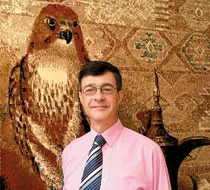
"Whatever you do, give Riyadh a wide berth,” was the advice given to Brian Salter when he came to the Kingdom for the first time in 1998. At that time, he worked for a company in Jeddah and the perceived wisdom there was that some places were best avoided and Riyadh was at the top of the list! In 2003, however, Salter moved to Riyadh to do PR with a British company. One of the first Brits that he met in Riyadh — a man who had spent 15 years in the city — told him there was “nothing to see or do in this God-forsaken city. The man said he only left his compound to go to the airport. But having worked as a journalist, Salter was not prepared to accept his compatriot’s assessment and he soon found the city full of interesting places to see — though it was very discreet about most of them.
“When I first came to Riyadh in 2003, I lost count of the number of people who told me there was nothing to do or see here, Since I seldom accept what people say in such matters, I began to look around and I found that the city had a lot to offer in terms of things to do and see.”
Salter noted that many Western expatriates are so cocooned in their compounds and jobs that they miss out on what is all around them. He commented, “There are stunning museums, which are virtually unknown to either Saudis or expatriates. Buildings that would earn looks of astonishment anywhere else are treated as commonplace since there are so many of them. The desert is beautiful in a very raw sense and the city has some fascinating souqs. To top it all off, the cost of living is very low.” the desert areas outside are beautiful in a very raw sense; there are some amazing souqs; the social life can be excellent. And the cost of living is very low.”
He admitted, however, that getting information about what is there, where it is, and when it is open for the public can be frustrating and, at times, almost impossible. For this reason, Salter decided to establish a special website that can provide this necessary information. He himself writes, takes the photographs, edits and lays out a bilingual monthly magazine for many companies; he constructs web sites, writes speeches, freelances all over the GCC and reads the news on Saudi Channel 2.
Though he has published a number of books, he agreed to research and write a city guide to Riyadh city but stipulated that it must be online in order to be accessed worldwide. This steered him off the beaten track and he discovered many places virtually unknown to Western expatriates and to the majority of Saudis as well.
Last week the website was officially launched. Salter explains, “It covers practically everything a person might want to know about the city — except for shopping as I doubt anyone needs to be pointed in right direction of the nearest and best malls!”
The website is divided into a number of different areas. A section on historical Riyadh includes pages devoted to historical sites and landmarks such as Di’riyah, Qasr Al-Hokm, and Murabba. There is also a section on some of the city’s unique architecture but there are also pages on the less striking buildings such as the railway station, airport terminals, Tuwaiq Palace, the TV Tower and King Saud University. Another section is devoted to the outdoors — parks, cemeteries, the Diplomatic Quarter, Janadriyah, and so on. There’s a big section on some of the many museums in Riyadh and of course the souqs, places to visit on day trips outside Riyadh, plenty of general information and a gallery of photographs. On every page there is a request for visitors to help update the site with anything new and to suggest new areas to be included.
The site has a dedication, which reads: “This site is dedicated to the people of Riyadh in appreciation of their wonderful city, and for the personal generosity I have experienced from so many Saudis. To them all, may I say a very big thank you!” Salter explained the dedication by saying that he has invariably found Saudis can be the most charming and generous of people.
“I think,” he went on, “that there are many misconceptions among Westerners about Saudis, and I wanted to set the record straight by making those Westerners stop and think a moment about their prejudices and also about how Saudis might view them.”
Salter spent a year collecting information for the website “I have visited all the sites that I have written about. Some places were very difficult to get information about. For instance, the Nasriyah Gate is a major monument yet not one Saudi friend of mine knew anything about it. Some even suggested that it was one of the original gates of Riyadh which of course it simply could not have been.” Salter said that he finally tracked down a website by an American who was in Riyadh in 1961. “It had pictures of the Nasriyah Gate when it was one of the best known landmarks in the city.” One of the best parts of the website is the pictures taken by Salter — though not without some difficulties and problems. “It’s easy to forget that it was only a little over a year ago that it was finally made permissible for the general public to take photographs in public places. Before that, I had to surrender my camera to the police for inspection when taking a picture in public.” But the biggest problem in taking photographs is the weather, as he pointed out.
“In many months the air is too dusty for clear photographs; and often the light is too intense and causes burn-out in the picture.” Salter pointed he had found the best time to take photographs was from January to March.
Salter of course has his own special places. “In the desert, the camel trail down the escarpment known as Camel Trail No. 1 is well worth a visit. And if one want to climb sand dunes, nothing is better than going to Karraragh’s red dunes. Bird lovers should make a point of visiting Riyadh’s lake area, south east of Al- Hair. The Diplomatic Quarter is an area which has wonderful walks through very well-designed parks.” He added that he often takes new arrivals to the camel souq in the northeast of the city.
Although he thinks that Riyadh has much more to offer, there are some frustrations. “I am not impressed by the intolerance of some people, which turns people off Islam which is a tolerant religion. Also the driving is terrible and endangers everybody. I also detest the amount of litter you see everywhere. This indicates a lack of respect for the environment.” For more information: http://www.riyadh-ksa.com/home/index.html