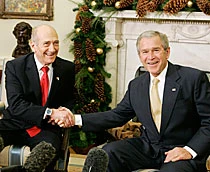
ANNAPOLIS, Maryland, 27 November 2007 — Hours before the opening of a high-stakes international conference on the Middle East, President Bush and Israeli Prime Minister Ehud Olmert expressed hope yesterday that peace finally could be achieved. A senior member of the Palestinian delegation said an elusive joint statement on the contours for future talks was within reach.
“I’m looking forward to continuing our serious dialogue with you and the president of the Palestinian Authority to see whether or not peace is possible,” Bush said after meeting with Olmert in the Oval Office ahead of the conference. Bush had a similar meeting scheduled with Palestinian President Mahmoud Abbas later in the day. “I’m optimistic,” Bush said.
Olmert said that international support — from Bush and also, presumably, from the Arab nations that will attend the conference in Annapolis, Maryland — “is very important to us” and could make all the difference.
“This time, it’s different because we are going to have a lot of participation in what I hope will launch a serious process negotiation between us and the Palestinians,” Olmert said, referring to the talks expected to begin in earnest after this week’s US-hosted meetings. “We and the Palestinians will sit together in Jerusalem and work out something that will be very good.”
Diplomats from over 40 countries — 16 from the Arab world, including Saudi Arabia and Syria — have descended on this sleepy, port city on the Chesapeake Bay, seeking to lend their support to today’s Middle East conference. Many are hoping that this daylong event, held on the autumn-hued yard of the US Naval Academy, will revitalize peace talks between Israel, represented by Prime Minister Olmert, and the Palestinians, represented by Abbas, president of the Palestinian Authority.
Lacking an official agenda, President Bush is hoping that informal “conversation” will motivate negotiators to re-commit to the “road map for peace,” a 2002 framework for the creation of a separate Palestinian state.
“What [the president] will do is to try and encourage the parties, encourage the diplomacy that make the ability of the parties to reach such an agreement more likely,” said White House press secretary Steve Hadley.
But the optimism of most Middle East watchers is more cautious. They say that the conference should have a formal agenda that deals with issues such as Jerusalem, borders, refugees, settlements, and donors, and that President Bush should declare his support for a joint declaration that says that resolution of these issues is key to peace.
“With a closing statements by [US Secretary of State Condolezza] Rice, the Palestinians, Israel, and even Bush, there is an opportunity to clearly signal change. However, everything depends on Bush,” says a State Department official who is an expert on the Middle East.
The official, who spoke to Arab News on the condition of anonymity, believes Bush should use firmer language with the Israelis on the issues of settlements and the building of a barrier between Israel and Palestinians areas. “The Israelis have an elastic interpretation of the word ‘freeze,’” said the official. “Bush must say in clear language that construction of the wall must stop and that construction of settlements — including the expansion of existing settlements — must come to an end.”
After months of trying to forge a joint outline, Israel and the Palestinians have made an 11th-hour push in recent days to come up with a statement for presentation at today’s gathering in Annapolis. It is to be the first time that Israel, a large group of Arab states and international envoys from around the world will sit down together to try to relaunch a peace process.
“We will reach a joint paper today or tomorrow,” Yasser Abed Rabbo, a senior aide to Abbas, told The Associated Press. “There is a persistent American effort to have this statement.”
Talks on the joint statement had faltered over a Palestinian desire that it address, at least in general terms, key issues of Palestinian statehood — final borders, sovereignty over disputed Jerusalem and the fate of Palestinian refugees who lost homes in Israel following its 1948 creation.
Israel has pressed for a broader, vaguer statement of commitment to two states living side-by-side in peace. It has promised to negotiate the contentious issues, however, in the formal negotiations that are to follow the conference.
Bush will open the Annapolis conference with a speech. He’ll make clear that Mideast peace is a top priority for the rest of his time in office through January 2009, but he is expected to conclude that the time is not right for him to advance his own ideas on how to achieve that, Bush national security adviser Stephen Hadley said Sunday.
“The Israelis and Palestinians have waited a long time for this vision to be realized, and I call upon all those gathering in Annapolis this week to redouble their efforts to turn dreams of peace into reality,” Bush said in a statement Sunday night.
The run-up to the meeting has been fraught with disputes, skepticism and suspicion about the opposing parties’ good faith. And expectations remain low. But Bush has been buoyed by Arab endorsement of the meeting and the possibilities for broader peacemaking.
Clinching a joint statement of objectives from Abbas and Olmert was seen as a tall order because of the charged issues that divide the two sides. Secretary of State Condoleezza Rice wasn’t able to bridge the gaps, even after eight missions to the region this year. Israeli and Palestinian negotiators met late Sunday with Rice in a last-ditch effort to wrap up the task.
John Duke Anthony, president of the Washington-based National Council on US-Arab Relations, believes that the large numbers of senior diplomats attending the conference makes it all the more crucial that Bush achieve tangible results.
“Not since Oslo 14 years ago have so many Arab leaders been gathered for a peace conference,” says Dr. Anthony. “For them, and the dozens or other international diplomats attending the conference, to go home and report that this event was a failure would do great hard to America’s reputation abroad.
“If the Annapolis summiteers can reach agreement that a State of Palestine of should be created within, say, the next 18 months,” Dr. Anthony added, “this will prove that this conference is something more than a photo opportunity.”
— With additional input from agencies.