
ALKHOBAR, 27 November 2007 — The death of a close relative or friend appears to be the only sort of “news” that I haven’t been sent yet in an e-mail. Two weeks back, my aunt became very ill. My sister telephoned from the US to advise me that Aunt Jean was in critical condition. “If she dies we’ll call you. The next 48 hours will probably be the worst,” advised my sister. “Whatever else happens, we’ll send you an e-mail.”
How splendid. For the next 48 hours after that phone call, I carried my mobile around like it was a bomb. I took a deep breath before answering any call coming in from the US. Insane thoughts ran through my brain such as, “If I stop answering the phone, can I keep Aunt Jean from dying?”
The bottom line was that e-mail was safe and phone calls weren’t. At 72 hours I got an e-mail from my sister telling me that Aunt Jean had survived a second round of surgery, but things still weren’t good. “Uncle George is asking for prayers,” my sister wrote.
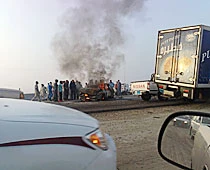
I get e-mail all the time about people dying. Fortunately, so far none of the dead folks have been my family members. If there’s a major traffic accident in the Kingdom, somebody will drop me an e-mail about it — and that’s fine. What I hate though is that they also tend to attach some photos of the actual accident scene — and that’s not fine.
You need to receive a picture of a man — dead in the driver’s seat of a vehicle with his head on the road beside the car, to appreciate the full horror of such images.
For goodness sakes folks, that was somebody’s son and perhaps somebody else’s brother, husband or father. Have a little respect for him! There was a cartoon in the Saudi press recently showing an accident victim reaching for help. Nobody was assisting him though because they were too busy taking his picture with their cell phones. That’s really the way it is.
It should be noted as well, that the more horrible the photos, the greater the chance they’ll be distributed. After a recent industrial accident, pictures of the burned bodies, supposedly taken at the accident site, started popping up in e-mail that same day. While the company was consoling the families of the dead, their colleagues were sending around grotesque images. Maybe that’s just inhuman nature, but it was tactless at best.
This is where we get to another issue, too. The pictures from that supposed accident scene had no identifying information. How could anybody be sure that the photos were really showing the true situation at that accident? It takes some work to retouch a very high resolution picture — but it’s doable. Retouching a low res digital image is something that third graders are now taught routinely. I believe that most of the photos circulating at the present time are actually true images. But in a short while, that probably won’t be the case. How long before vehicles that weren’t involved in accidents are magically inserted into accident images — especially corporate vehicles? And if a little blood in a picture gets a reaction — what about more blood and some missing limbs? The possibilities are endlessly horrible.
I used to think it was awful when people sent me tasteless jokes. Then the scam e-mails started coming. These were about everything from get rich quick schemes to the dangers of eating certain imported chocolate bars. Such mails were immediately topped by a woman who decided to “get even” with a former partner. She sent me — and perhaps a hundred other people on her mailing list — views from the man’s “private” Facebook page. The photos of dead accident victims are of course even nastier than that.
Some of the mails going around are outright slander. Despite the Kingdom having laws that prohibit slander, I don’t see that there is any effort to stop such e-mails from circulating. For example, currently, there’s a campaign against Bangladeshis. E-mails are being sent out reporting on the purported criminal actions of Bangladeshis in the Kingdom. Perhaps one in ten of these reports are true and the others are complete fabrications. But most people believe whatever they read in those mails and “criminal Bangladeshis” have become a hot topic at every social gathering.
Since olden times, gossip was a primary form of entertainment in Saudi Arabia. There is still a joke that the Saudi grapevine is faster than the Internet — but I think it’s a close contest. I spend a lot of time — too much time, on what I call “rumor control.” I’m not alone. Thanks to e-mail abuse, the rumor situation is so bad that Saudi Aramco has actually set up two telephone numbers for Rumors Control — 872-4488 and 872-4499.
One reason of course that the spreading of “information” by e-mail is so ubiquitous in the Kingdom is that everybody knows that there is some important news that will never appear in the mainstream media.
Most people blame government or social control for those omissions — neglecting to add in the commercial interest factor, i.e., loss of advertising revenue if certain news becomes public. Consequently, the common folk in Saudi Arabia have taken matters into their own hands.
People spend a significant amount of the working day in the Kingdom, along with work resources, ensuring that the word gets out. But when the word is about your family it can be unbelievably painful. Just imagine that your sister was killed in a car crash and by the time you came back to work a few days later, everybody in the office not only knew how your sister died, but had learned most of the details about her death from an e-mail. That e-mail contained the facts of the accident, plus photos and video of it as well. Of course, the inevitable happened. One man, in his haste to get out the “news” sent the e-mail to everybody on his mailing list — including the dead woman’s relative. Yes, the reaction to that was ghastly, but there was no deterrent effect on those devoted e-mailers — who didn’t even take a one-day break from their mission to get out the news.
So, what’s the conclusion of all this? Please think twice before you send out the news by e-mail. Do at least minimal checking to ensure that you are distributing news and not fiction. If people find out that your news is fiction — then they’ll think you’re an idiot. If you still chose to attach a nasty photo to a mail — mention that detail in the e-mail subject line. I have now rigged my e-mail not to open attached photos automatically — known as “displaying attachments inline.” It saves me from horrible nightmares. Last, if you’d like to pray for my Aunt Jean, she’s still very ill. You might also say a prayer for those families wronged by people’s need to make misery an online spectator sport.
Comments to: [email protected]