
AT Sotheby’s in central London, there is a delight for lovers of travel and history. On display are several hundred rare and valuable books as well as old maps and photographs.
They take us back to different times and different places. Some date from the 15th century and there are photographs and books about trips to the Holy Land and into the desert.
Two of the collections on view attracted special attention. Both include rare documents and photographs that are the result of two men’s efforts. One of them went to the Arabian Peninsula and the other to Libya. Each recorded his journey with photographs and documents, which have not become a unique historical record for both places.
Muhammad Afandi Saudi, an employee of the Egyptian Ministry of Justice, examined old documents in order to distinguish between what was genuine and what was fake. His job gave him skilled eyes that came to love the camera and what it could do.
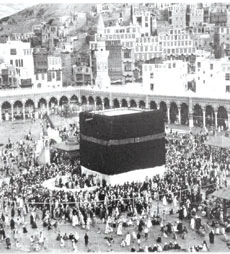
When he joined the caravan of Egyptians pilgrims going to Makkah to perform Haj at the beginning of the 20th century — the group also included the writer Ibrahim Rifat Pasha — his plan was to take photographs of both Makkah and Madinah. From his photographs, we see what the two cities looked like over a hundred years ago; we see the architectural styles of the buildings around the Two Holy Mosques. Although the photographs have the feel of a documentary, they also reflect the vision of an artist. The pictures of the Prophet’s Mosque in Madinah are particularly fascinating. Muhammad Afandi took photographs of the inside and outside of both holy mosques and in his pictures, we see what has vanished from the two cities. In the photographs are also a range of people — pilgrims, residents, merchants, and passers-by — who reveal to us a great deal about themselves, the ambience of the two cities and the world they lived in. One of the most interesting pictures taken by Muhammad Afandi is of the caravan from Cairo, which is bringing the Kiswa (the covering for the Holy Kaaba) all the way to Makkah. In those days, a new Kiswa was brought from Egypt every year.
Among the displayed items, which will be auctioned is a book by Rifat Pasha entitled “View of the Two Sanctuaries” (Miraat Al-Haramain). It includes a number of pictures of Makkah and Madinah during the years from 1901 to 1908. Another rare book for sale, written by Ali Bek Hafez, is called “Essential Improvements For The Utilities of Two Holy Mosques” (Al-Islahat Al-Lazima Limarafek Al-Haramain Al-Sharifain) and is dedicated to Muhammad Afandi . In addition to the rare books and photographs there are also many manuscripts by the Egyptian intellectual Sheikh Muhammad Abduh; some of them are also dedicated to Muhammad Afandi Saudi. A photograph of the two men together was also exhibited.
The manuscripts include an Arabic translation of Plato’s Republic in addition to a number of issues of the Islamic revolutionary journal, Al-Urwah Al-Wuthqa, by Jamaluddin Al-Afghani along with Muhammad Abduh in Paris in 1884.
Richard Fattorini, a Sotheby’s expert on travel books and maps, elaborated on the significance of these manuscripts which belonged to Sheikh Muhmmad Abduh. He explained, “There were only four of his manuscripts known until another three were recently found. The family of Muhammad Afandi Saudi who had had the manuscripts for years didn’t know their real value. The manuscripts are very rare and we expect strong bidding competition from potential buyers. I estimate the prices will run from £12,000 to £18,000,” he said.
Sheikh Muhammad Abduh was born in 1849 into a middle-class family in the Nile Delta. He received his education at Al-Azhar, and then became one of the most well-known promoters of Islamic teachings, following his master and role model Jamaluddin Al-Afghani whom he met in Paris.
Also of interest in the exhibition are issues of Abu Nazara magazine, an Egyptian satirical magazine published in 1877 by Yaqub Sanoa. Sanoa was known for his satirical spirit and was nicknamed “The Arab Moliere.”
He was given a scholarship to Paris where he studied with Jamaluddin Al-Afghani, Sheikh Muhammad Abduh, Mustafa Kamel and other famous figures.
There is also a collection of photos and newspaper clips recording the years spent by Ahmad Muhammad Hasanain Pasha at the court of King Fuad of Egypt and at the court of Fuad’s son, Farouk, who was the country’s last king. Hasanain Pasha was head of the Royal Court during the reign of King Farouk and he was the king’s trusted advisor and consultant. Hasanain Pasha was a lover of the desert. He recorded his many trips to Libya with photographs and books. One of his best-known books was written in English and published in 1926, “The Missing Oasis.” Fattorini said, “Hasanain Pasha was a man of many talents.
He was an explorer and traveler who graduated from Oxford University and made a famous trip from London to Cairo by plane.”
The collection is preserved in elegant volumes. It records Hasanain Pasha’s official missions and his trips with King Fuad to Britain in 1927. There is also one of his albums with pictures of the Egyptian royal family at different ceremonies.
These photographs also reflect the interiors of the royal palaces in the time of King Farouk. The collection is expected to fetch from £25,000 to £35,000.