
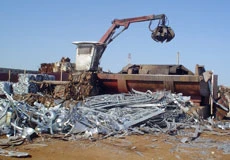
DAMMAM, 29 November 2007 — As the Kingdom becomes more environmentally conscious, there is increasing interest in recycling and reusing resources. Recycling makes good sense, not only from the perspective of protecting the earth, but it contributes positively to the economy, both through job creation and income generation.
Metal recycling is one of the oldest, and continues to be one of the most successful, forms of material reclamation. Saudi Arabia reuses scrap metal locally and regulations allow for excess scrap metals such as iron, steel, aluminum and copper to be exported, mostly to Asian nations for recycling.
Founded in 1978, Al-Sale Eastern Co. Ltd has been a leader in the recycling of ferrous metal, with a focus on steel recycling. This includes scrap from old automobiles, construction materials and equipment, household appliances, industrial scrap and food packaging. Ferrous scrap accounts for the largest volume of metal scrapped and is classified into numerous grades.
“We have been working in steel scrap for a long time — since SABIC started in Saudi Arabia,” said Yousef A. Al-Dossary, managing director, Al-Sale Eastern. “Before, we used to deliver our material in the Kingdom, initially for Saudi Iron and Steel Company (Hadeed) and also for Al-Ittifaq Steel. In the future, we hope to begin talks with Al-Rajhi Steel in Jeddah in order to start meeting their requirements. However, the steel mills in the Kingdom don’t use all the scrap collected locally and that excess is exported.”
Scrap processors such as Al-Sale Eastern, collect, sort, process, and eventually sell the scrap metal to foundries, mills and other purchasers.
“We collect what is required by the local factories. Scrap that is clean and in the desired size is nearly always delivered locally. This makes economic sense,” explained Al-Dossary. “For example, HADEED wants the best material to be entered into their furnaces. They are concentrating on size No. 1 steel that’s free of white goods and light gauge materials. The steel must be more than six millimeters thick and less than 1.5 meters in length. This helps them to increase their production.”
Hadeed wants high-quality scrap that has a low level of impurities and a size that has been controlled and/or modified by mechanical means. This type of scrap is the most expensive and only used in the latter stages of steel processing. To meet Hadeed’s requirements, Al-Sale Eastern uses heavy equipment including cranes and hydraulic shears to reduce scrap steel to the desired size.
“Once we meet the amounts of scrap needed locally, we export the remainder,” said Jayantha D. Nandaraj, GM, Al-Sale Eastern. “In the end, about 50 percent of the scrap we handle is exported. That averages about 5,000 tons monthly. Most of the exported scrap is type No. 2.”
Al-Sale Eastern exports steel scrap to India, Pakistan and the Far East using brokers. “We have agents,” Al-Dossary said.
“We load the scrap into a ship at Dammam or Jeddah and the agent pays for the transportation. This business is growing. More than a year ago, new regulations came into force. Custodian of the Two Holy Mosques King Abdullah decided to lift restrictions on the export of scrap and that has led to a growth in our business and better support for the price per ton. I should also mention that people are more aware now. They understand the requirements of the scrap industry. Instead of letting an old refrigerator just sit abandoned in a trash heap, now they sell it for scrap.”
Until recently, the scrap market was unpredictable and prices for scrap steel were poor. With increasing demand, higher prices have been offered to the sellers and this has spurred the collection of scrap metal from around the Kingdom. “Now with the high price, there are more scrap yards and people all over the Kingdom are loading scrap into their pick up trucks and bringing it in,” Nandaraj said. “Even people who used to sell vegetables and fish have now switched and are collecting scrap. This is why we have scrap to sell abroad.”
With increasing exports to Asia, the role of brokers and agents has taken on new importance. Al-Dossary believes that using reliable agents is essential when exporting scrap steel.
“We try an agent once and see how the transaction goes. For us, the relationship with the agents is personal. We want to ensure that the transaction is carried out under mutually beneficial terms and that timelines are met. This requires some measure of trust,” he said. “We use the Internet to check the prices and terms internationally and this can result in our making adjustments in future contracts, but the business itself isn’t done online. Al-Sale provides the best quality product, so we actually have more agents who want to do business with us than we could possibly serve.”
It is not just the Kingdom that has liberalized its regulations in regards to exporting scrap steel. Asian countries as well have opened their borders to the scrap metal trade. “It used to be difficult to comply with all the regulations,” Nandaraj said. “It was really a problem to export scrap to India — not from our side — from theirs. To transfer money, for them to receive the steel, it was all a problem. The globalization of the marketplace is helping.”
And because of the relative closeness of the Kingdom to Asia, there is considerable interest in Saudi scrap — especially when the rising cost of fuel is factored into the equation. The ships that come to the Kingdom are loaded with goods for the market here. In the past they sometimes had to leave port empty. Now, those that can, load up with scrap metal, which they take back to the Asian markets. This has been beneficial for the shipping industry.
About a quarter of a million new households are formed in Saudi Arabia each year and one local manufacturer estimated that the demand for steel in the Kingdom grows by about seven percent annually. With the boom in housing construction, the demand for white goods and a young population snapping up products from automobiles to electronics, anyone can see that the amount of scrap metal available can only increase and the demand for new steel will ensure that the price for scrap remains high.
“With the introduction of our new shredder in the coming year, we predict that we will be able to process as much scrap steel as the market can provide,” Al-Dossary said. “I believe the future for the scrap metal trade will be very bright.”