
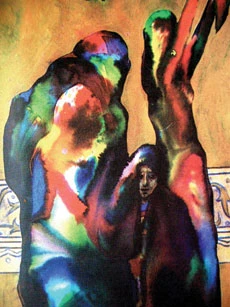
THERE was no better art school for them than Italy. Six Saudi artists took their talents there and polished their skills in the land of Michelangelo and Leonardo da Vinci. The six artists, Mohamed Al-Saquabi, Kamal Al-Muallem, Ahmed Felemban, Othman Al-Khuzaim, Mohamed Mansour Al-Aajam and Dia Aziz Dia, were honored recently with an exhibition that showed the fruits of their studies and experiences. The exhibition was at the Italian Cultural Center here in Jeddah, last week, with each artist showing seven or eight paintings.
“This exhibition was a witness of special links between different cultures such as Italy and Saudi Arabia. An artistic sense has no boundaries. Italy has given the tools of inspiration and we are seeing result that we are very proud of,” said Adriano Maria Santacesaria, consul general of Italy.
Ahmed Felemban’s paintings dealt with the situation of women in Saudi society. For him, women face problems, as there are many obstacles for them here that do not exist abroad. One of the paintings showed a group of women with a man in the background turning his back on them as if he didn’t care. “In our society, a woman is a problem everywhere; in addition, she is exposed to trouble all the time. You will see that in my paintings. I prefer people to interpret my paintings as they see them,” Felemban said.
Felemban went to Italy in 1967 as a secondary school graduate with a talent for painting. He got a scholarship to study at the Academy of Rome and graduated with honors in 1971. The education minister at that time was Hassan Al-Alsheikh who was also an artist. He wanted to establish an art academy in Jeddah but was unable to do so.
“When I graduated and came back to Jeddah, the environment here was not ready to receive us and my only option was to teach and that was what I did,” said Felemban. He and his colleagues who studied in Italy merged Italian tools and techniques with Saudi culture as scholarships from the Saudi Ministry of Education continued year after year until 1985. “Our Saudi art has no identity, we are still looking for an identity. Saudi art needs to be shaped by having a society or a school to supply the basics,” Felemban commented.
The paintings of Mohammed Al-Saqabi, who graduated from the Art Academy in Florence, are abstract. He depends on a balance between dark and light colors. “My work is the result of mixing lines and colors,” he said.
Kamal Al-Muallem showed three phases of his work: paintings that he did before going to Italy, paintings done while in Italy and paintings since his return to Saudi Arabia. His recent paintings focus on stallions and individual parts of their bodies. His use of colors is bolder as he tends to concentrate on dark colors.
During the exhibition, Lamborghini, one of the sponsors, brought a white wall for people to spray graffiti on. Most of the guests, including Jeddah Mayor Adil Faqeeh enjoyed spraying the wall and creating a canvas of abstract art.