
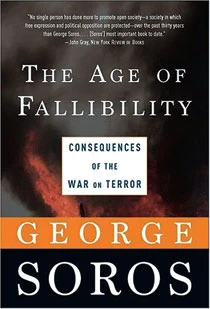
IN his latest book, “The Age of Fallibility: The Consequences of the War on Terror,” the self-made billionaire, George Soros, presents a sharp and informative view on what is wrong with the United States. He believes that the US has become a feel-good society unwilling to face unpleasant truths which explain why Americans have been so easily deceived by the Bush administration.
The author of nine books, the Hungarian-born Soros escaped Nazi Germany in 1947. Barely seventeen and penniless when he arrived in England, he found odd jobs and got a degree from the London School of Economics. He then went to the United States where he settled and began to amass a huge fortune and went on to become the second richest investor in the US. He is a member of the elite collectively known as the “Thinking Rich” which also includes Bill Gates and Warren Buffett. Best known for masterminding the devaluation of the British pound in 1992 and netting $1.1 billion (US) in the process, his financial success is largely based on his ability to predict trends in international markets and making the right choices: “Stock market bubbles don’t grow out of thin air. They have a solid basis in reality but reality as distorted by a misconception. Under normal conditions misconceptions are self-correcting, and the markets tend toward some kind of equilibrium. Occasionally, a misconception is reinforced by a trend prevailing in reality, and that is when a boom-bust process gets under way. Eventually the gap between reality and its false interpretation becomes unsustainable, and the bubble bursts,” he explains.
“The Age of Fallibility” is in two parts. In the first, the author clarifies his conceptual framework as a point of departure. In the second, he uses this framework as a means for understanding history: “My purpose in the book is to examine how our inevitably imperfect understanding of reality, and our misconceptions, actually shape current events... I should like this book to serve as a guide that not only I, but also other people, may use in their efforts to improve the world.”
His views are considerably bolstered by theories pertaining to financial markets and economics. He actually compares the Bush administration policies to a stock market bubble and strongly criticizes its post 9/11 policies. He accuses the administration of fostering and increasing the fear that plagued the United States and using that fear to serve its own interests. He is also a staunch critic of the war on terror: “Terror is an abstraction. One cannot wage war on an abstraction. We have the means to destroy any target as long as we can identify it, but terrorists rarely provide an identifiable target.” As a result, Soros concludes that the world is less secure and less stable than it was when Al Qaeda attacked the United States and the counter-productive war on terror is threatening America’s leadership role in the world: “In the aftermath of 9/11, we enjoyed almost universal sympathy and support in the world. Since then, public opinion has turned against us... the decline in American power has been much greater than anybody could have anticipated.”
The author is also deeply preoccupied with the state of America. He searches for the fatal flaws not only in the current administration but also in American society. He believes that an excessive admiration of success, measured in monetary terms, to the detriment of more humane values, is one of the shortcomings of American society: “When a society admires success, no matter how it is achieved, the safeguard against cheating and lying and other sharp practices is diminished. People become disillusioned and cease to expect high standards of integrity from their leaders... The untrammeled pursuit of success provides an unstable basis for society.”
George Soros also says intellectual honesty and integrity are the values that America needs to rediscover if it is to recover. Many tend to blame the media but the media essentially caters for its audience. Presently, most Americans wish to be entertained, not informed. America has turned into a feel-good society with the rise of consumerism and the application of consumerism to politics. In their search for increased profits, corporations no longer deal with commodities but brands which they sell through marketing strategies and advertising campaigns. Firms no longer cater to customers’ needs but to their desires. Sophisticated methods of market and motivational research manipulate the consumer’s emotions. “Gradually, the methods developed for commercial purposes found a market in politics... Politicians learned to cater to the desires of the electorate instead of propounding policies they believed in.”
This study, especially the first part, is rather tedious and complex but Soros also offers a pragmatic point of view and the credibility of a financial whiz. “The Age of Fallibility” offers a fresh look at what can go wrong in the world of politics and governance as “mankind’s power over nature has increased cumulatively while its ability to govern itself has not kept pace.” It also warns us that a global economy, based on the principles of market fundamentalism (a belief that the common interest is best served by people pursuing their self-interest), is full of uncertainties.