WASHINGTON, 14 December 2007 — It will be interesting to see how the Administration will juggle this one: on the same day his top diplomat said her president plans to take a more active role in the Israeli-Palestinian peace process, the State Department announced diplomatic posts and US embassies worldwide will be cut by 10 percent because of heavy staffing demands in Iraq and Afghanistan.
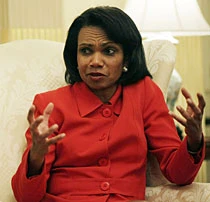
The cuts come as the Bush Administration has stepped up diplomatic efforts in hotspots such as the Middle East and North Korea, which Secretary of State Condoleezza Rice discussed in recent interviews. Rice told USA Today on Wednesday that President George Bush would be visiting the region because “he very much wants to signal support for the bilateral process between the parties and to continue in a hands-on way to encourage them to move forward.”
She said Bush’s decision to travel to the Middle East in January was to shore up the new Israeli-Palestinian peace negotiations that were launched November 27 at an international conference he hosted in Annapolis, Maryland. Rice said she could not say exactly how Bush would intervene because it is unclear what issues will surface in the next two or three weeks.
At the Annapolis summit, Bush told both Israeli Prime Minister Ehud Olmert and Palestinian Authority President Mahmoud Abbas that the US would be “actively engaged” and help the parties.
Throughout his presidency, Bush has taken a low-key approach to peacemaking. Rice has visited Israel eight times this year to facilitate negotiations, but Bush will be making his first official trip to the region.
Rice said Bush would visit the broader region “because holding together Arab support for the Palestinian-Israeli track is just really critical.”
Saudi Arabia, Syria and 12 other Arab League members attended the Annapolis conference, which launched the first serious Palestinian-Israeli peace talks in seven years.
The Palestinians cannot make “tough choices without Arab support,” while the Israelis will find it difficult if they are not sure they will reach a broader peace with the Arabs, said Rice.
The Bush Administration has faulted former president Bill Clinton’s Administration for not having greater involvement from the surrounding Arab states as one of the reasons the Oslo process didn’t succeed, but it also added that former PA chairman Yasser Arafat as the main reason for the failure.
Rice also had some critical words for Israel and its decision to allow further construction in the Jerusalem neighborhood of Har Homa. “This is a time to build confidence between the parties and... something like the Har Homa activity undermines confidence,” she said.
Also on Wednesday, the White House announced it again had suspended the move of the US Embassy to Jerusalem for another six months.
In a separate interview with The Associated Press, the secretary said North Korea and Iran still have a long way to go to get off the Bush administration’s list of nuclear threats. In light of last week’s retrenchment of US claims that Iran is seeking an atomic weapon and word of new diplomatic and cultural outreach to North Korea, Rice was asked whether the US still considers those nations part of President George W. Bush’s “axis of evil.”
“They are clearly still states about which there are significant proliferation concerns,” Rice said during an Associated Press interview at her State Department office. “It would be very irresponsible not to deal with those dangers.”
Rice told AP she took overarching responsibility for the Blackwater debacle in Iraq. “Of course, anything that happens in this department, I’m ultimately responsible,” she said.
Rice brushed aside Iranian President Mahmoud Ahmadinejad’s suggestion that the findings of the National Intelligence Estimate, or NIE, could open better relations with the United States. “Since they have embraced the NIE, I assume that are embracing the entire thing,” Rice said. “And that means that they must have had a weapons program and that means that they have a lot to answer for.”
Meanwhile, back at the State Department, the decision to eliminate Foreign Service positions reflects the reality that State does not have enough people to fill them. Nearly one-quarter of all diplomatic posts are vacant after hundreds of Foreign Service officers were sent to Baghdad and Kabul, and Congress has not provided funding for new hires.
Many have criticized Secretary Rice for failing to focus on management issues. They say her predecessor, Colin Powell, paid close attention to management details, while she has not. The cuts will not affect consular positions, which are funded by visa and other fees.