MINA, 12 December 2007 — Civil defense helicopters play a significant role during the Haj by monitoring the movement of pilgrims between the holy sites, transporting accident victims to hospitals and helping in fire-fighting and rescue operations.
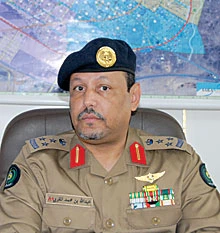
The commander of civil defense helicopters, Brig. Abdullah Maghrabi, said during an interview with Arab News that “Our main activities during Haj are the distribution of relief supplies and the transportation of those injured in accidents.” He went on to say, “On the day of Arafat we usually transport many sick and injured pilgrims to hospitals in Makkah and Jeddah to provide them with specialized treatment. We also rescue pilgrims trapped in hilly areas in Mina and Arafat.”
The department coordinates with other government departments, including the Health Ministry, in order to provide the best possible services to the guests of God. “Five helicopters can fly at the same time on a specific mission through a specific air corridor and a sixth one can join them by flying through a corridor above them,” the commander said, explaining the modalities of the whole operation.
“Generally, the helicopters used for firefighting fly at 5,000 feet or less while those used for taking pictures fly at 2,000 feet or more,” he said. Helicopters that spray insecticides fly through the lowest air corridors while air force planes are in the highest ones.
The commander also spoke about different types of training provided to civil defense helicopter pilots. “They sometimes undergo special training abroad,” he said. Most pilots are recruited from King Faisal Air Academy. “We send some pilots abroad for higher studies and flight training,” Maghrabi said. Helicopter navigators and other support staff receive training at the Institute of Civil Defense and the Technical Institute in Dhahran. “We also provide on-the-job training to pilots and support staff at aviation bases in order to carry out certain missions, including rescue operations,” the commander said. Officers in charge of providing first aid services are trained at institutes under the Health Ministry.
Asked whether cloudy climatic conditions would obstruct the activities of the brigade, the commander said not. “We receive weather reports daily and if we find the weather troublesome, our helicopters are grounded and when the weather is safe, they resume their rescue, relief and evacuation missions,” he explained.
Brig. Yahya Anani, commander of aviation in the holy sites, said 10 helicopters of the civil defense were used to monitor the movement of pilgrims. “They are distributed all over the holy sites especially to monitor crowded areas and possible fires,” he said. Asked whether the brigade faced any difficulties, Anani replied: “By the grace of God, we don’t face any problems as our pilots and navigators are well-trained and are fully aware of the geography of the holy sites.”
He said the civil defense would use special boats in times of floods in the holy places, adding that the boats are the first of their kind in the world. “We have already used them and found them very effective,” he added.
Brig. Abdullah Al-Aufi, a senior officer in the civil defense and in charge of coordination, emphasized the importance of civil defense helicopters as they provide vital information to the operations room in the event of an emergency calling for quick action. “All these planes can fly at a height of 12,000 feet and in some cases at 14,000 feet,” he added.