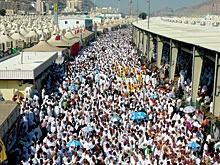
MINA, 20 December 2007 — Supervisors went under the King Abdul Aziz Bridge at 11 a.m. yesterday in order to control the crowd of pilgrims that threatened to become dangerously congested. According to the Haj Ministry’s program to control and monitor pilgrims’ movement to Jamrat, there were six routes for pilgrims returning from Jamrat. However, police officers at Jamrat blocked five of them, directing all returning pilgrims into a single one.
“I saw the congestion beginning to build up among the returning pilgrims from Jamrat and rushed to control the situation before it escalated,” said Wael Milibary, senior supervisor of the program to control and monitor pilgrims’ movement to Jamrat. “My job was to watch the pilgrims movement from Jamrat on monitors and coordinate 250 people on site who are under my supervision.”
Milibary told Arab News that the flow of pilgrims’ movement had now become organized and constant. Arab News, however, had to wait for almost an hour under King Abdul Aziz Bridge in order to find a route out.
Lost pilgrims hounded Milibary trying to get their bearings. “I’m staying near Bin Dawood Supermarkets, but I was forced to come this way. I’m missing my bus back to Aziziah; how do I get back?” said 55-year-old Ahmed, a Sudanese pilgrim.
The work of many organizations and the result of much preparation were apparent all over Mina and Jamrat.
There were signs in different languages telling the pilgrims to carry nothing with them to Jamrat. There were also signs asking pilgrims not to push while in the crowd. There were also barriers to separate the pedestrian walkways of pilgrims going to and coming from Jamrat. Despite instructions, many pilgrims still carried hand luggage with them — blankets, laptop bags and food. There were also pilgrims who insisted on pushing and there were other pilgrims either pushing or jumping over barriers.
Garbage cans of all sizes and in many colors were distributed all over Mina. Yet despite their high visibility, many people preferred to throw their litter on the ground instead of in a garbage can a few feet away.
The pilgrims asked officers and boy scouts many questions, most of them concerning Haj rituals and camp locations. The badges that pilgrims wear should include camp details. All Haj camps are numbered but unfortunately, many pilgrims’ badges didn’t include the essential information. This made it harder for officers and guides to direct lost pilgrims.
“Countries must work harder to make sure that the pilgrims coming to perform Haj are better informed about everything related to Haj, the rituals and the camps,” a scout said. “Haj is already an overwhelming experience. Pilgrims don’t need these avoidable inconveniences.”