
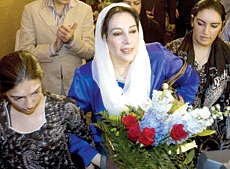
DUBAI, 28 December 2007 — Supporters of slain Pakistani opposition leader Benazir Bhutto in Dubai, where she made her base through eight years of exile, were left in shock yesterday following her assassination two months after she returned home. “I’m so sad. I feel that my own sister is dead,” said Zubeir Bashir, Middle East spokesman for Benazir’s Pakistan People’s Party.
“This is a big tragedy for Pakistan. This is a very big shock for us,” he told AFP by telephone as he headed to the Bhutto family home in Dubai. Bashir said that members of Benazir’s family who had remained in the Gulf emirate after her return to her homeland in October were already on their way to Pakistan.
Her husband Asif Zardari was urgently awaiting a flight back to help make the funeral arrangements, Benazir’s spokesman Farhatullah Babar told Pakistani state television.
Dozens of cars were seen outside Benazir’s home in an upmarket neighborhood of the city last evening while police deployed to try to prevent press photographers from taking pictures.
The leader of Benazir’s party in the United Arab Emirates, Mohammed Akran Farooqi, choked with emotion as he tried to express his grief over her killing in a suicide attack in the Pakistani city of Rawalpindi. “I can’t say anything... I’m totally upset,” he said between sobs.
Benazir had received threats that suicide bombers would be sent to kill her before she returned home, but on the eve of her departure from Dubai in October she insisted she was undeterred. “I don’t believe that a true Muslim will make an attack on me... Islam forbids suicide bombings,” she told reporters.
Benazir, the charismatic opposition leader assassinated yesterday, was the first woman prime minister of a Muslim country and an icon for democracy in Pakistan.
She came from a political family steeped in Pakistan’s turbulent history. Her father — also a former premier — and her two brothers all died violent deaths as Pakistan struggled to come to terms with its identity since its birth 60 years ago. Benazir, 54, had just addressed a campaign rally for Jan. 8 parliamentary elections when the suicide bomber blew himself up at the venue in Rawalpindi, near the capital Islamabad, killing her and at least 10 other people.
It was the second suicide attack targeting Benazir since she returned from eight years of self-imposed exile in October. The first struck a welcome home rally, killing 139 people.
Over the next two months she led opposition to President Pervez Musharraf, notably during his six-week state of emergency, all the time cannily steering her Pakistan People’s Party — the largest opposition group in the country — into contesting elections.
Educated at Oxford and Harvard, Benazir became the first female premier of a Muslim country when she took the helm in Pakistan in 1988. Her father, also a Pakistani prime minister, was hanged by the military in 1979.
Recalling standing at his grave, she once wrote: “At that moment I pledged to myself that I would not rest until democracy had returned to Pakistan.” Often seen in the Western world as an icon of democracy in a conservative Muslim Pakistan, Benazir was one of the country’s shrewdest politicians.
Her political skill stemmed from her blood stained family history, years of combat against a former military regime from jail — and finally two terms in power in the shark-infested waters of Pakistani politics.
“I didn’t choose this life, it chose me,” she wrote in the introduction to her memoir, “Daughter of the East.” “Born in Pakistan, my life mirrors its turbulence, its tragedies and its triumphs.”
Benazir was born in Karachi on June 21, 1953, into a powerful land-owning dynasty. She was the oldest of four children of her Westernized father and an Iranian Shiite mother. It was a heritage that would both give her a sense of destiny and weigh her down.
After attending convent schools in Pakistan, she went to Oxford University, becoming the first Asian woman to head its prestigious Oxford Union debating society.
But months after she returned to Pakistan in 1977, her father Zulfiqar Ali Bhutto, by now prime minister, was deposed by Gen. Zia-ul Haq, and she and her family were detained. On April 4, 1979, her father was executed.
She remained under detention until 1984, when Zia allowed her to leave for England where she became the leader in exile of her father’s party.

