
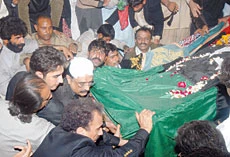
ISLAMABAD, 29 December 2007 — Benazir Bhutto was buried in her ancestral home in the southern Sindh province yesterday, a day after she was killed in a gun-and-bomb attack in Rawalpindi.
The government called in the army to quell violence by her supporters that has taken a toll of 32 lives since Thursday. The government also said that nationwide elections scheduled for Jan. 8 will go ahead.
Tens of thousands of mourners wept and beat their chests as Benazir’s coffin was carried from her ancestral home in Naudero to the domed family mausoleum at Garhi Khuda Bakhsh.
Her husband, Asif Ali Zardari, wept as he accompanied the closed coffin, draped with the green, red and black tricolor of Benazir’s Pakistan People’s Party, on the 7-km journey to the tomb. He then prayed at the tomb with the couple’s three children — son Bilawal, 19, and daughters Bakhtawar, 17 and Aseefa, 14.
Opposition leader Nawaz Sharif declared that his party will boycott the poll and said that if the government went ahead with the elections, it will “destroy the country.”
“If the government is adamant about holding elections on Jan. 8, it is going on a self-destructive path which will not only destroy the government itself but will also destroy the country,” Sharif told reporters.
“They are not going to be credible,” he said. “Most of the mainstream political parties have announced their boycott.”
He said the “No. 1 demand” of the nation was for President Pervez Musharraf to resign as soon as possible. “Mr. Musharraf has to step down. This is the No. 1 demand of the nation today. And I can see that people want this to happen as quickly as possible without any delay,” he added.
Pakistan’s Interior Ministry said yesterday that Benazir died from hitting her vehicle’s sunroof when she tried to duck during the attack, and that no bullet or shrapnel was found in her.
Ministry spokesman Brig. Javed Cheema said the opposition leader had died from a head wound she sustained when she smashed against the sunroof’s lever as she tried to shelter inside the car. “The lever struck near her right ear and fractured her skull,” Cheema said. “There was no bullet or metal shrapnel found in the injury.”
But a top aide to Benazir rejected the government’s explanation of her death as a “pack of lies.” “It is baseless. It is a pack of lies,” Farooq Naik, Benazir’s top lawyer and a senior official in the PPP. “Two bullets hit her, one in the abdomen and one in the head,” Naik said. “It was a serious security lapse.”
At his news conference, Brig. Cheema said intelligence services had intercepted a call yesterday from the man considered to be Al-Qaeda’s top figure for Pakistan, Baitullah Mehsud, congratulating a militant after Benazir’s death. He said there was “irrefutable evidence that Al-Qaeda, its networks and cohorts are trying to destabilize Pakistan.”
He said Sharif is one of several politicians under threat of attack. “There are other people who are under threat and whenever we receive information we pass it on to the people concerned,” Cheema said.
Asked to give examples, he named Sharif as well as Islamist leader Maulana Fazlur Rehman and former ministers Sheikh Rashid and Aftab Sherpao.
Protests continued for a second day yesterday after the assassination and the violence was worst in Benazir’s home province in the south. Officials said 32 people, including four policemen, had died since her murder on Thursday.
The death toll included six people who were burned to death when an angry mob torched a factory in Karachi yesterday. “The mob stormed into a leather factory in the Qur’angi area of Karachi. They set it on fire and six laborers were burned to death,” police official Latif Siddiqi said.
The workers had stayed in the factory overnight because there was no transport to get them home, after opposition leaders called for a national strike to protest Benazir’s killing.
Siddiqi said rioters also burned down a BMW car showroom and ransacked a medicine factory and a private hospital in the same area of the city, Pakistan’s largest and the economic hub of the country.
A top official said that the army had been called in to help keep order in several cities in the south of the country. The government of Sindh province has requested the army’s help “to control the law and order situation” in the cities of Karachi, Hyderabad, Mirpurkhas, Nawab Shah and Gotki, said Ghulam Mohammed Mohtaram, the province’s home secretary.
A mob in Karachi looted at least three banks and set them on fire, and engaged in a shootout with police that left three officers wounded, police said.
About 7,000 people in the central city of Multan ransacked seven banks and a gas station and threw stones at police, who responded with tear gas. In the capital, Islamabad, about 100 protesters burned tires in a commercial quarter of the city.
Angry mobs burned 10 railway stations and several trains across the Sindh province, forcing the suspension of all train service between Karachi and the eastern Punjab province, said Mir Mohammed Khaskheli, a senior railroad official. The rioters uprooted one section of the track leading to the Indian border, he said.
Investigators reconstructed a mangled human head yesterday hoping to identify the man suspected of killing Benazir in a gun-and-bomb attack as she left an election rally in the city of Rawalpindi.
“We have retrieved a head and it has been reconstructed. We also found fingers and we’re carrying out DNA tests to make a comparison between the head and fingers,” said Saud Aziz, police chief in Rawalpindi.
A man shot at Benazir as she waved to her supporters from the sunroof of her bullet-proof car. He then blew himself up. The blast killed 17 other people.
Aziz said samples had been taken from the site for testing to determine what type of explosive had been used.
The White House yesterday said it was confident that Pakistan’s nuclear arsenal was secure and did not risk falling into extremists’ hands after Benazir’s assassination.
“At this time, as far as I know, it is the assessment of the intelligence community that Pakistan’s weapons arsenal is secure,” spokesman Scott Stanzel told reporters near the president’s ranch in Crawford, Texas.
Stanzel did not say whether President George W. Bush, who is spending the remainder of the year at his Texas home, brought up the nuclear question during a phone call to Musharraf yesterday. But he acknowledged that it was a major topic of discussion between US and Pakistani officials amid fears of further instability in the wake of Benazir’s death.
Stanzel said “there have been discussions” with army chief Gen. Ashfaq Kiyani on “what we can do to help on the political and security front, while we’re having conversations with people throughout Pakistan.”
— Additional input from agencies

