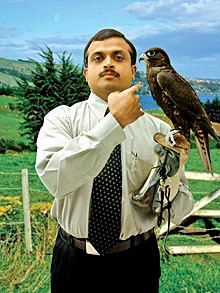
JEDDAH, 9 January 2008 — Medammal Zubair, the first Asian scientist to win a doctoral degree in falcon studies, has cautioned owners of the regal bird in Saudi Arabia and other Gulf countries about the possibility their prized possessions getting infected by avian flu through their food sources.
“They should show extra care while feeding falcons. Because, many falcons in North America, Germany and the Gulf have died as a result of feeding on avian flu-infected birds and other preys, especially pigeons and quails,” Zubair told Arab News.
“We should give the food to falcons only after thorough clinical examination. We should keep the (dead) prey in the refrigerator after examination and when we take them out to feed falcons we should examine them again because falcons are extremely sensitive to the H5N1 virus,” he said.
Zubair warned that falcons are already under threat due to a shortage of prey (due to the expansion of agricultural activities in their habitats), accidents caused by human-related activities and, most important, the effect of pesticides.
“About 35 percent of falcons die after eating prey that has been exposed to pesticides,” he said.
The orinthologist said migratory falcons that fly over Italy often get shot down by hunters thanks to a local demand for their feathers used in decorative knick-knacks and clothing. “This has affected the number of falcons migrating from different countries,” he said.
Zubair also talked about a project in India where falcons would be used to drive away birds that are likely to hit planes. “We have already presented this project to the Civil Aviation Ministry,” he added.
Zubair and P.A. Azeez, director of Salim Ali Center for Ornithology and Natural History (SACON) in Anaikatty, Coimbatore, India’s largest ornithology center, gave the ministry an idea about how falcons could be used to drive away birds that hit aircraft.
Zubair said Burj Al-Arab in Dubai, the world’s tallest building, had been using falcons to scare away birds that used to leave their feces on the top of the building. In Manhattan, birds of prey that decide on their own to nest on the ledges of high-rise buildings are allowed to remain there for the same reason.
Arabs account for one-third of falconers in the world and they import falcons from European countries, especially Germany, which has a suitable climate. Germany is a major breeding center for falcons.
Zubair has received special training in artificial falcon breeding from Stuttgart. He won his doctoral degree from the University of Calicut after six years of research on the bird. He has visited several Arab countries as well as Germany to complete his research projects.
He is the first non-Arab to get a membership of the Emirates Falconers Club and the first to prepare a sonogram of 15 different sounds of falcons. He is a member of Worldwide Fund for Nature and Natural Resources.
Zubair says a falcon lays a maximum of four eggs in a year. Half of the eggs are destroyed, he said, emphasizing the need for artificial breeding. The birds usually live on top of mountains, towers and other secure places.
“When a falcon goes on a hunting flight, its speed can reach 350 km per hour. It cuts the cervical vertebra to kill the prey and eat its liver,” he added. There are 37 species among falcons and Zubair’s studies focused on five of them. Readers can log onto his website falconpedia.com to get more information on falcons.