RIYADH — On his first trip to the region since taking office in May, French President Nicolas Sarkozy flew into Saudi Arabia yesterday at the beginning of a three-nation Gulf tour.
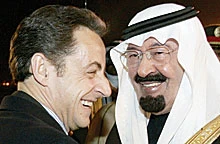
The French presidential Airbus plane arrived at King Khaled International Airport shortly after 6 p.m. Sarkozy was given a traditional Saudi reception. Custodian of the Two Holy Mosques King Abdullah welcomed him on arrival and the two leaders were seen with their arms locked together, as they walked down the aisles of the palace.
Dozens of riders from the National Guard, raising Saudi flags on one side and French flags on the other, slowly trotted ahead of Sarkozy’s motorcade to the Al-Qubba Palace in Nasseriya where the two leaders later held talks.
Sarkozy, who described the Kingdom as a “strategic partner in the region” and a “bridge between the East and the West” during an interview with an Arab newspaper, seeks to take the strategic ties between the two countries to new heights.
“My relationship with King Abdullah is based on trust and confidence,” Sarkozy said in the interview. He mentioned that he shared similar viewpoints on a wide range of regional and international issues with King Abdullah.
The French president praised the economic reforms initiated by the Saudi government in the past few years and said Saudi diplomacy never ceased to act as a “mediator of peace” in the region.
Discussions between the two leaders were expected to focus on the political situation in Lebanon and Iraq, the political turmoil in Pakistan, the Iranian nuclear standoff, and violence in some African countries. Later in the evening, King Abdullah hosted a dinner in Sarkozy’s honor.
The French president is accompanied by six ministers, including Minister of Foreign Affairs Bernard Kouchner, Minister of Finance Christine Lagarde, Minister of Justice Rachida Dati, Minister of Education Xavier Darcos, Minister of Defense Herve Morin and Minister of Culture Christine Albanel. Also accompanying the president are several heads of France’s biggest corporations.
Four memorandums of understanding are to be signed during the visit — two relating to training and rehabilitation, focusing on areas where Saudi youth could receive training in France. A third agreement will focus on the energy sector and a fourth will be between the Foreign Ministries of both countries to boost cooperation.
Sarkozy had earlier mentioned that French corporations were capable of meeting the demands of the Saudi market. He particularly mentioned the areas of transport and energy in which French companies seek to build active partnerships with Saudi companies.
The Ministry of Culture and Information yesterday held a welcome reception for French journalists covering the visit. In addition to being entertained by Saudi folk dancers, ministry employees distributed booklets that highlighted the Kingdom’s cultural, economic and political aspects. The ministry has also set up two information centers for visiting journalists covering Sarkozy and US President Bush’s visits.
Sarkozy is expected to deliver a historic speech at the Shoura Council today. He is scheduled to address a large gathering of Saudi businessmen on economic reforms in France.
Foreign Minister Prince Saud Al-Faisal is expected to meet his counterpart Kouchner today. The two will discuss political issues and hold a joint press conference. The French president is due to leave the Kingdom this evening, heading to Qatar as part of his tour in the region. His departure is hours before the expected arrival of President Bush.
Saudi Arabia is France’s No. 2 trading partner in the region and trade between the two countries is rapidly increasing. France is the Kingdom’s eighth ranking supplier. More than 60 French companies are already established in Saudi Arabia and are contributing to the Saudi economic boom. These companies are benefiting from the open economic policy introduced by the Saudi authorities.
Sarkozy travels to the United Arab Emirates tomorrow, where he is scheduled to sign a framework accord for cooperation in developing civilian nuclear energy.
The agreement will be the third signed by France with an Arab country, after accords inked last year with Algeria and Libya.
“The sharing of civilian nuclear (technology) will be one of the foundations of a pact of confidence which the West must forge with the Islamic world,” Sarkozy said after signing the agreement with Algeria last month.
UAE Energy Undersecretary Ali bin Abdullah Al-Owais has said the Gulf states aim to have a joint nuclear reactor by 2025.