
RIYADH, 4 February 2008 — As Sri Lanka celebrates its 60th anniversary of its Independence Day today, W.S.M.S. Wijesundera, charge d’affaires of the Sri Lankan Embassy, here reiterated the country’s commitment to strengthen the strong ties between the island and the Kingdom. “Ever since we established diplomatic relations with the Kingdom in July 1974, the two countries have been maintaining excellent relations in social, cultural, political and economic fields,” Wijesundera said on the eve of his country’s national day. He added that the relationship with Saudi Arabia is significant not only because it is home to 550,000 Sri Lankans but also it is a holy land for the Muslims who form seven percent of the country’s 24 million population.
The Sri Lankan Embassy in the Kingdom was established in Jeddah in late 1981. This was reciprocated by the Kingdom with a Saudi mission in Colombo in 1994. The Saudi mission was elevated to an ambassadorial status with the appointment of Mohamed Mahmud Al-Ali as its first ambassador in 2001. The Kingdom, he said had lent its helping hands during the devastation caused due to tsunami. “Tsunami waves took away the lives of 35,000 Sri Lankans and rendered 500,000 people internally displaced,” said Wijesundera.
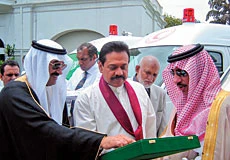
“The Muslim population, which had a large concentration on the eastern part of the island, lost one percent of its population.” “ Saudi Arabia’s assistance came at the right time and it still continues to support the deserving people who were affected by this natural calamity,” he said, adding that housing city comprising 500 houses are being built for the tsunami victims and 10 ambulances were also given by the Saudi Red Crescent to hospitals in the affected region. The housing scheme, which will be named after Custodian of the Two Holy Mosques King Abdullah, will have 500 houses, two schools (one for boys and the other for girls), a hospital, a mosque, a playground, a bus terminal and a shopping mall. He said this was not the first time that the Kingdom had come to assist the island. It has always extended assistance in times of natural and man-made calamities.”
Recently, the Saudi Fund For Development (SFD), released a grant of SR40 million for the construction of the National Neuro-Trauma Center in Colombo. Earlier, SFD has provided the island with project loans on three previous occasions. It had offered SR99.9 million for the second stage of the Water Supply and Sewage project and gave SR48.1 million for the Mahaweli Ganga Development Project System B in 1981. Subsequently, Sri Lanka obtained SR85 million for the Mahaweli Ganga Development Project System B Left Bank in 1984.
In 1985, under the Mahaweli Development Project, Sri Lanka built a model town in the ancient city of Polannaruwa in the eastern part of Sri Lanka where a large market was named as “Riyadh Market”.
During the last Ramadan, the Kingdom donated 223 metric tons of dates to the Muslims of Sri Lanka on the advent of the holy month. Riyad Al-Kheneini, charge d’affaires, of the Saudi Embassy in Colombo handed over the consignment to Deputy Foreign Minister Hussein Bhaila in Colombo.
When thousands of Muslims in Muttur were displaced due to terrorist activities in the eastern part of the island, the Kingdom sent a planeload of relief aid to Colombo, he said. The 150-metric-ton consignment containing 2,000 waterproof tents, 4,000 blankets, 2,000 carpets, medicines and food items were distributed under the direct supervision of a six-member Saudi team headed by Saad Al-Wetaid from the Ministry of Finance. “The Saudi aid benefited more than 2,000 families in Muttur,” the diplomat said.
Another deal worth SR40 million for the construction of a bridge and widening a highway in the island was signed between the SFD and the Ministry of Finance. The accord was inked between the vice chairman and director general of the Saudi Fund For Development (SFD), Yusuf Al Bassam and the island’s Minister of Finance, Dr. Sarath Amunugama.
The bridge, which would link the eastern town of Trincomalee with Kinniya, a Muslim village will be completed by the end of August this year. Currently, there are 100,000 people living in Kinniya and they are using ferry as their mode of transport to come to Trincomalee, the northeastern capital of the island. The Trincomalee-Batticaloa highway is also being widened with the same funds allocated under the agreement.
The Kingdom has also agreed to train Sri Lankans in the field of oil exploration. This was the outcome of the talks between Abdul Hameed Mohamed Fowzie, minister of petroleum, petroleum resources, and Ali Al-Naimi, minister of petroleum and mineral resources. Sri Lanka buys 10 percent of her oil requirements from the Kingdom. Sri Lanka has conducted seismic surveys in 2002 and 2005 that revealed that there are high chances of finding oil in the Mannar Basin, which covers an area of 35,000 km, stretching from Mannar in the northeast to Kalutara in the south.
Studies revealed last week indicated that there is a potential for one billion barrels of crude oil in the Mannar offshore basin. The international arm of the ONGC has already bought the Norwegian group TGC NOPE’s seismic survey for one million dollars for acquiring data on the Mannar Offshore Basin.
As an effort to helps its domestic aides working in the Kingdom, Sri Lankan Embassy operates a round-the-clock help desk for expatriate workers who may seek embassy assistance when in distress. The runaway maids who seek refuge at the mission are kept in a safe house, run by the mission with the assistance of the Sri Lanka Bureau of Foreign Employment (SLBFE). Wijesundera said that this year the officials at the labor wing of the mission were successful in collecting large sums of monies as compensation for those unpaid housemaids and on behalf of those workers who died in accidents in the Kingdom. “The collection runs into millions of Sri Lankan rupees.”
“We have also extended our consular service to Al-Hasa where there is a sizable concentration of Sri Lankan workers,” Wijesundera said, adding that it was in addition to the services offered in Alkhobar. The diplomat said that he has plans to organize programs in cooperation with SriLankan Airlines to promote the island as a tourist destination. He pointed out that the Saudi tourists are heavy spenders and they look for South Asian destinations for their holidays. “We have plenty of attractions to offer for Saudi tourists but hitherto we have not harnessed this lucrative market effectively,” he added.
In this respect, a tourist brochure on Sri Lanka was launched in Riyadh to promote the island as a family destination for Saudis and expatriates in the Kingdom. The brochure, displaying the details of the tourist facilities and attractive tailor made packages for Saudi customers, was sponsored by Unique Choice International, the leading wholesale tour operator in the Kingdom. “Despite problems created by the LTTE in the north, Sri Lanka is still a safer place for a family holiday,” Wijesundera said. He pointed out that so far, no tourist had been targeted by the rebels. He added that Saudi families who had visited Sri Lanka had always opted to repeat the visit because of the island’s natural scenic beauty and the hospitality of its people. “Muslim visitors will feel at home in the city of Colombo since they could see mosques in the vicinity of every shopping center,” he said.
In fact, he said, women in abayas are a common sight in the city. “A good number of Saudis are currently visiting Sri Lanka for their leisure and honeymoon.” The island has some 11,000 quality rooms and it is studded with quality hotels such as Grand Cinnamon, Taj Exotica, Light House, and Kandalama for the comfort of luxury tourists.
SLES, which functions under the umbrella of the Riyadh Mission, runs a free medical clinic besides funding deserving projects back at home. The SLES played a prominent role in the tsunami relief efforts undertaken by the embassy. It donated medical equipment to Sri Lankan hospitals. The society built 100 houses for flood victims in central parts of the island and also donated medical equipment to the Jaffna Hospital. It constructed and installed 23 rainwater harvesting tanks in drought-stricken areas of the country.
The largest state-owned People’s Bank as well as a leading private bank, Seylan Bank, maintain representative offices in the Kingdom to provide services to the Sri Lankan community in sending remittances to their families back home. Top Saudi Banks, such as the Arab National Bank (ANB) — Telemoney, Al Rajhi Bank also offer special services to expatriates for fast and convenient money transfers.
Telemoney, speed remittance service of the Arab National Bank, has introduced a new service which gives an automatic insurance cover for the remitter in case of an accidental death during a period of 12 months from the date of remittance. The beneficiary from the other end would receive SR1,300 monthly for one whole year. Remittances through Telemoney will enable the beneficiary to receive cash within 30 minutes.