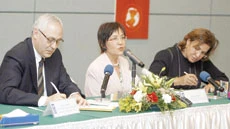
RIYADH, 14 February 2008 — The Special Rapporteur of the Human Rights Council on Violence Against Women has accused members of the Commission for the Promotion of Virtue and Prevention of Vice of human rights abuses by harassing, threatening and arresting women who “depart from accepted norms.”
Yakin Erturk, who has been in the Kingdom at the invitation of the government, was on a 10-day fact-finding mission. She spoke to the press at the end of her mission.
During her visit, she met government officials in Riyadh, Buraidah, Jeddah and Dammam, the head of the Shoura Council and representatives of various groups, including academics, human rights organizations, family protection centers, women’s groups, victims of violence and women at the central prison in Riyadh.
She also had discussion with representatives of diplomatic missions, the Organization of the Islamic Conference and the EU and the UN country teams.
Citing the case of Yara published in Arab News recently, Erturk said: “It is a telling example of harassment when a businesswoman from Jeddah is arrested while having coffee with her male colleague in a public place. She was subjected to humiliating and illegal treatment before she was released the following day.”
The commission members are law enforcers responsible for maintaining morality in public place, she said, indicating that although they are required to act in concert with the police and under certain limitations with respect to arrest and detention of people, “they often reportedly act independently and are accountable only to the governors of the respective regions.”
The rapporteur said the full report of her findings would be submitted to the UN Human Rights Council and the purpose of her press briefing was to share her preliminary observations.
In recent years, she said, a number of positive developments have taken place regarding women in the Kingdom. “The most noteworthy has been in the area of women’s access to education, which has resulted in a significant improvement in literacy rate among them in a relatively short period of time.”
She added that women were enjoying free and virtually full access to all levels of education and that the ratio of girls attending school is equal to or higher than that of boys. However, she lamented that the progress in women’s education had not been accompanied by a comparable increase in their participation in the labor force.
Notwithstanding the significance of many positive developments, she said the lack of women’s autonomy and economic independence, practices surrounding divorce and child custody, the absence of a law criminalizing violence against women and inconsistencies in the application of laws and procedures continued to prevent many women from escaping abusive environments.
The recently adopted judicial reforms which foresee the establishment of family courts, together with a draft law on domestic violence, were “promising initiatives,” but more needed to be done to fight violence against women. Among needed reforms are a legal framework based on international human rights standards that would cover violence and family matters, the establishment of a “national machinery for women” to intervene in cases of violence, and “positive action policies and plans” to empower women.
She noted that she had been informed by the Ministry of Justice that a directorate for women within the ministry would be created in order to coordinate and support the functions of the family courts.
Answering a question about Fatima Azzaz and Mansour Al-Timani, who were forcibly separated by a court in the Eastern Province, she said: “I met them and they are in a terrible state of mind.” She said that officials had pledged that arrangements would be made for their reunion.
Speaking about the judicial system, she noted that Islamic values are not interpreted as they should be. Emphasizing the implementation of the rule of law, she said: “We are all human beings and tend to err. There should be clear laws to protect people’s rights.”
In response to a question, Erturk commented that migrant domestic workers are placed in extremely vulnerable conditions. “Without sufficient monitoring mechanisms, they are left to the mercy of their sponsors and often have no knowledge of any rights they may have in their own countries,” she said.