
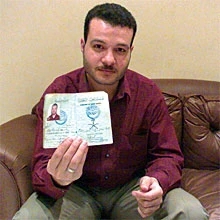
MAKKAH, 5 March 2008 — A man, whose Saudi father divorced his Egyptian mother over 20 years ago, is calling on the Saudi authorities to grant him citizenship and officially recognize his lineage.
The 29-year-old man, called Bahauddin, has neither Saudi nor Egyptian citizenship. His father, Abdullah, married his mother unofficially only to divorce her and return to the Kingdom five months after Bahauddin’s birth.
Bahauddin’s mother had to pay for his education in state schools because he was not an Egyptian. Unable to meet costs, she withdrew him from school after primary education.
The 29-year-old Bahauddin had tried to obtain Egyptian citizenship on several occasions, but to no avail. Each time, Egyptian authorities asked him to bring his father’s ID, something that he was unable to do.
Exasperated by his situation, Bahauddin visited the Saudi Embassy in Cairo 14 years ago, where he learned that a file on him existed. The embassy contacted his four siblings in the Kingdom — two brothers, Abdul Rahman and Turki, and two sisters. However, none of them responded.
Later with the support of his brother Abdul Rahman and a sister, Bahauddin received permission to travel to the Kingdom and file a lawsuit to prove his identity citing the witnesses listed on his mother’s divorce certificate. In addition, his brother Abdul Rahman expressed a desire to list his name to their father’s inheritance.
The witnesses, who were mentioned in the divorce statement, testified in court, as did Abdul Rahman and one of his sisters, who said that before his death their father had confided to them that he had a son in Egypt.
After several months delay, the court finally accepted Bahauddin’s claim and acknowledged his relationship to Abdullah. However, the presiding judge told his half-brother Turki that if he did not accept the verdict he could appeal at the Court of Cassation within 15 days.
Following this, Bahauddin was surprised to receive a court request asking him to undergo a DNA test, which he underwent. Results came negative and, subsequently, the court asked Bahauddin to provide new evidence proving his identity in spite of testimonies of his brother and the witnesses.
Turki said that his father had asked him not to acknowledge Bahauddin’s relationship to them if he was to come one day. “When Bahauddin first came to me, I welcomed him and I told him frankly about our family’s intention not to acknowledge him officially as our brother. He then went to our eldest brother Abdul Rahman, who helped him to proceed with the case,” he said.
Following the court ruling, Turki appealed at the Court of Cassation and suggested the court orders the brothers to undergo DNA tests, which came negative. However, the court has given Bahauddin a chance to prove his relationship if he can come up with new evidence.

