JEDDAH, 7 March 2008 — When a woman begs a surgeon to place a lap-band around her stomach through keyhole surgery to help her quickly lose weight, revive her marriage and stop her husband from taking a second wife, what is the surgeon to do?
Women think that the lap-band solution — a form of restrictive weight loss surgery designed for severely obese adults — is a form of cosmetic surgery to restore and improve a person’s appearance, said Dr. Manal Marghalani, a consultant psychiatric at the King Fahd Hospital, who specializes in obesity and eating disorders.
The lap-band system is designed for severely obese adults, who have a body mass index of at least 40, have been obese for at least five years and for whom nonsurgical weight loss methods have been unsuccessful, according to the US Food and Drug Administration (FDA).
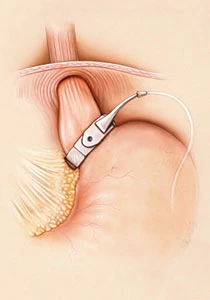
Using keyhole surgery, doctors place an inflatable silicone prosthetic device around the top portion of the stomach to control how much a person eats.
Marghalani said that if an obese patient abroad has diabetes or hypertension, the government is obliged to provide treatment — the costs of which are covered by one’s health insurance. “We don’t have a similar health insurance system here and people think of weight loss surgery as cosmetic surgery,” said Dr. Marghalani. “I have repeatedly said that if a woman complains to her doctor that she needs the lap-band surgery because she’s a TV presenter, that she wants to be thin, that she is losing her chances of getting married, or that her husband is going to marry another woman, then the doctor must not accept her request,” she added.
Haifa, 25, underwent lap-band surgery when she was 16. Obesity is a genetic problem for her, something that has caused her back pain. Following the surgery, Haifa cannot eat without immediately vomiting.
“Twelve members of my family underwent lap-band surgery to lose weight... the surgery was successful in helping me lose weight. I now vomit a lot. I feel I can’t hold food in,” said Haifa, adding that nine years of suffering has disciplined her and taught her how to adjust her eating habits.
Dr. Adnan Sabbahi, a consultant general and laparoscopic surgeon at King Fahd Hospital, said the primary way in dealing with obesity is to go on behavior modification programs. “When there’s no change in a patient’s lifestyle, the chances are the patient won’t lose weight in the long run,” he said.
“Many patients think that they can simply install the adjustable gastric band (a lap-band) and then do whatever they like. The surgery is just an effective solution with long-term results that aren’t permanent or forever,” he added.
According to the FDA, patients, who opt for this type of surgery, must make the commitment to accept significant changes in their eating habits for the rest of their lives. The first step is for the patient to admit that there’s a problem, said Dr. Sabbahi.
“I can’t force my patients to exercise regularly or to stop eating. Sometimes patients become depressed after surgery. The doctor didn’t provide them with enough explanation or probably gave them high expectations. So when the patient doesn’t meet his or her goal, he or she then becomes frustrated,” he added.
One 27-year-old woman underwent lap-band surgery 10 years ago after trying nonsurgical treatment to lose weight. After losing 40 kilos, certain complications occurred and she had to redo the surgery and replace her old band with a new one. She said that there were many side effects and complications to the procedure, and her health isn’t the same anymore.
“My health isn’t as good as it used to be prior to the surgery. My eating habits have become so difficult and I’m constantly running to the bathroom to vomit,” she said. “One is deprived of the pleasure of food. I can’t go to restaurants anymore with friends and family. I think women resort to weight loss surgeries, thinking it’s the easiest way to lose weight.”
The FDA provides information about the lap-band system. In a warning section, the FDA outlines surgery is a major type and can cause death. It also says that it is the responsibility of the surgeon to advise patients of known risks and complications.
Dr. Sabbahi said that sometimes doctors aren’t completely honest in explaining to patients everything they need to know about the surgery. It is a doctor’s job to explain to patients all side effects and that they should not simplify or complicate things. The more the doctor is experienced, the fewer the side effects.
“There are always risks in any operation. It’s just like taking medicine. There are always side effects. So when someone says that the lap-band surgery has no side effects, I believe he’s a liar,” said Dr. Sabbahi.
Dr. Marghalani, who received her education in Canada, said that doctors there no longer use lap-band surgery. “My thesis in Canada was to prove that lap-band causes eating disorders. What I want surgeons and people to understand is that it’s all about lifestyle. It’s easy to follow any type of diet and lose weight, but then who is maintaining lost weight?” she said.
According to a recent report in Asharq Al-Awsat, 2,500 lap-band surgeries are performed annually and that the majority of patients are women. Dr. Sabbahi said that this is due to the fact that there are more women than men. “85-90 percent of my patients are women. At the King Fahd Hospital we do approximately 1,500 adjustable gastric band operations a year,” he said.
Umm Muhammad, a 49-year-old mother of seven, has been overweight all her life. She neither has the strength nor the willpower to control her eating habits. It is only when she developed knee problems that she realized she was overweight.
“I’ve lost 50 kilos just by eating smaller portions of food, drinking plenty of water and walking on the treadmill everyday for at least an hour,” said Umm Muhammad. “It has truly changed my life for the better. I’m healthier, I’m lighter and I’m aware now that a healthy lifestyle is what every woman needs.”
Dr. Marghalani told Arab News that she advises women to be patient before taking the decision to undergo lap-band surgery. “We need to promote healthy lifestyles instead of the diet paranoia. I don’t want people thinking that to lose weight they should either go on a strict diet or do the surgery,” she said.
“One should check what’s wrong with his or her eating habits. Is it the portion? The calories? Is there too much fat and carbohydrates? Is he or she an active person? From my experience, the lap-band surgery disciplines people, who have disordered and abnormal eating patterns,” she added.